I see good businesses go missing from ChatGPT's answers... here is how to get ChatGPT to recommend your business
Field noteMeasured 2026-11-02
I see good businesses go missing from ChatGPT's answers... here is how to get ChatGPT to recommend your business
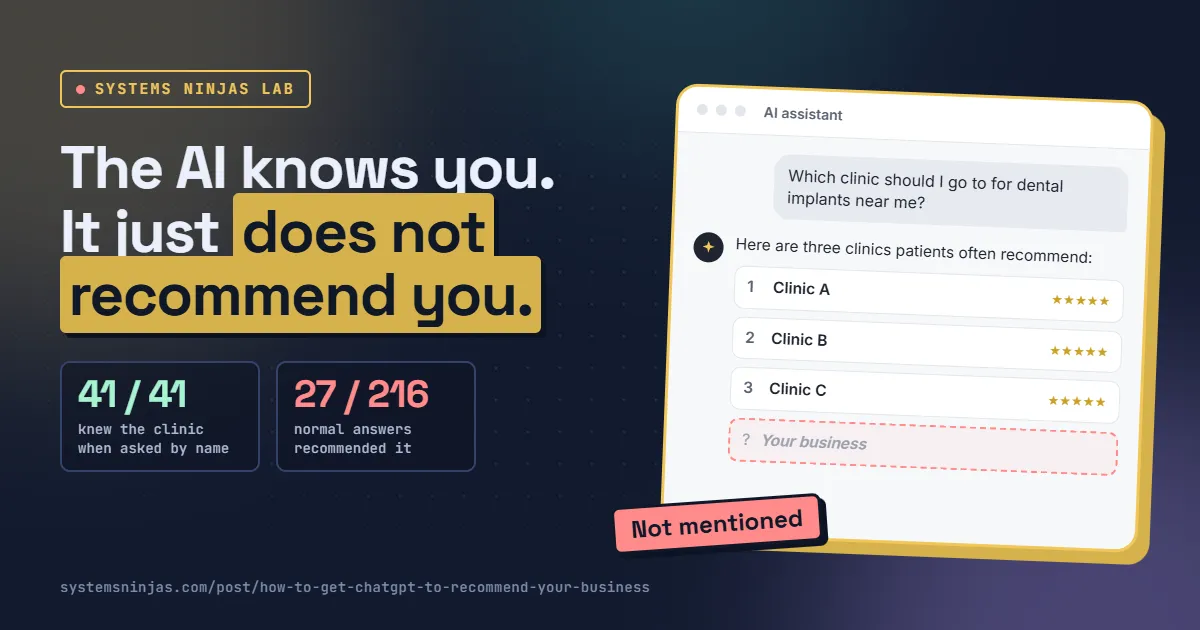
It is not because they are bad. In one market, we asked AI tools about a well-reviewed clinic BY NAME. They knew it in 41 answers out of 41... but in 216 normal answers, they recommended it in only 27.
That is 12.5%. The AI knows you. It just does not recommend you. It is like a taxi driver who knows your shop, but never takes tourists there.
The customer who asked never heard your name. So they never show up: no missed call, no unanswered message. They booked with someone the AI did name... and you never knew they asked.
This page is for any business that people find by asking. A restaurant, a tax adviser, a clinic or a plumber gets picked by the AI in the same basic way.
We measured one kind of business: dental implant clinics. Why? A clinic owner sent me this exact question on WhatsApp on 2026-11-02: "How do we get recommended when someone asks ChatGPT or Google's AI for a dental implant clinic?"
So the clinic is our example all the way through. When you read "implant", put in whatever you sell.
One thing to know up front: we sell help with this kind of work. So I will show you what you can do yourself first. I will also show you where our own tests found that something does NOT work.
The short answer
You cannot pay to be the business ChatGPT recommends. There is no button for it.
Someone asks an AI tool "where should I go for dental implants near me?" Or "a good tax adviser for people moving abroad". Or "a restaurant for a birthday dinner for 8". The AI usually does a quick search. It reads what it finds, then writes an answer from it.
It is a bit like a student writing a report in a hurry: it uses the books on the table. And it repeats what the web keeps saying about you.
So the useful question is: what does the internet say about my business, and does it say the same thing everywhere?
Look at your website, your Google profile, your reviews and the directories. (A directory is a website that lists many businesses in one place.) If they all tell one clear, matching story, the AI has something safe to repeat. If they tell four different stories, or almost nothing, it names someone else.
The worked example: what 216 AI answers about implant clinics showed
On 2026-11-02 we asked six AI tools the questions a patient would ask about dental implants in Petaling Jaya, Malaysia.
The answers spread out more than you would think. We asked 10 questions that did not name any clinic. That gave 216 answers. Between them, they mentioned close to 300 different clinic names. (Some are the same clinic spelled two ways, so the true number is lower.)
A typical answer named 5 clinics. The most-named clinic appeared in 64 answers, 30%. The top 10 were each named in somewhere between 20 and 64 answers.
So nobody owns this question... but a top group keeps coming back. If your market looks like this one, the door is still open.
Answers naming each clinic
Each AI tool told a different story. We asked every tool the same questions. Here is how often that well-reviewed clinic was named:
How often each tool named the well-reviewed clinic
Checking one tool tells you about one tool.
The AI read directories, not the business's own website. The four sites cited most often were medical-tourism and clinic booking directories. ("Cited" means the AI named the site as a source.) They were cited in 116, 103, 74 and 60 answers. The well-reviewed clinic's own website was cited in 13.
Answers that named each site as a source
A restaurant has its own version of these sites: food guides and booking apps. An adviser has professional listings and review sites.
Old facts kept travelling. That clinic had three different prices for the same treatment. One was in its ads. One was on its website. One was in an old social media post. The AI repeated the old one.
Mix-ups happen. One AI tool put that clinic's address and website under a different clinic's name.
Whole groups of customers never saw it. There were 44 answers to questions from international patients. The clinic appeared in 0 of them. We also asked in Malay and in Chinese. In one of those two languages, the clinic came up in a handful of answers. In the other, never.
How we did it. We asked 12 patient-style questions: 8 in English, 1 in Malay, 1 in Chinese, and 2 that named the clinic. They covered "near me" searches, treatment and price, international patients, and other languages.
We asked them on six AI surfaces. (A surface is one place where you can talk to an AI.)
- the ChatGPT app (5 runs per question)
- the Gemini app (5)
- Google AI Mode (3)
- Google AI Overviews (whenever one appeared)
- Perplexity through its API (5)
- Claude through its API (3)
An API is a door that lets a computer program, not a person, talk to the AI.
That gave 257 answers, 216 of them to the 10 questions that did not name any clinic. A cheap AI model listed the clinics named in each answer. A simple text match checked it. We settled the 5 disagreements by hand.
What this cannot tell you. It is one market, one kind of business, on one day. So treat it as an example of how this works, not a rule for your city or your trade.
We did not measure restaurants or advisers. We are saying the AI reads the web the same way for them. That is reasoning, not a result.
The six surfaces are different products. So the pooled 12.5% (all six added together) is a summary, not a market share. The two API surfaces are not identical to the apps people use. The Claude surface returned 29 answers instead of 30. Answers change from one try to the next.
We did not log in, create accounts or contact any clinic. We name no clinic here, good or bad.
"Can we not just correct the AI?" We tested exactly this
A long-term client of ours has people who use the AI tools every day. They search for their own business and read the answers. When the AI gets something wrong, they type in a correction.
You type "that is not correct, here are the real facts". The AI says "thank you, you are right". It feels like the problem is solved.
We checked. On 2026-10-21, our client's team corrected ChatGPT about what a public review site said about them. Six days later, we asked the same question in 5 fresh ChatGPT sessions. (A fresh session is a new chat that does not remember the old one.) All 5 still pointed to the same review page, and all 5 still described the same recent negative reviews.
"That is not correct, here are the real facts."
"Thank you, you are right."
5 fresh chats
Same negative reviews.
Same negative reviews.
Same negative reviews.
Same negative reviews.
Same negative reviews.
When you correct the AI inside a chat, you are only talking to your own conversation. The next customer gets a fresh chat. The AI goes back to the web and reads the same pages again.
It is a bit like arguing with a newspaper seller about a headline. He can agree with you, but tomorrow's paper still says the same thing.
So here is the honest split:
- Correcting the AI in a chat: a placebo. A placebo feels like help but does nothing. It changes your screen, not the next customer's answer.
- Checking the AI regularly: useful. The answers move. In the same test, Gemini changed its answer between runs on 6 of the 19 questions we asked. ChatGPT changed on 1 of 19. One check a month cannot tell a real change from a different roll of the dice. Asking the same questions many times, and counting, can.
- Changing what the web says: the thing that moves the answer. Your pages, your reviews, one matching set of facts, and the other websites that mention you.
Limits of that test: it was one business (not a clinic) and one corrected question. The 5 sessions were collected within the same minute, in one country. It shows that one in-chat correction did not stick. It proves nothing about how long a fix on the web takes.
(The client's own website was a source in 60 of 95 ChatGPT answers in that test, so your site matters. It is just not the only thing the AI reads.)
What the AI actually reads about your business
Think of a new customer asking five friends about you. If all five say the same thing, he believes it. If one gives your old address and three have never heard of you, he goes somewhere else.
Here is what the AI reads. The list is roughly in order, from the fastest fix to the slowest. Each part shows the clinic version first, then what it means for other businesses.
- 1Google profile and reviews
- 2A real page for what people ask
- 3One name, address, phone and price
- 4Other websites that mention you
- 5Your customers' languages
1. Your Google Business Profile and your reviews
Take a local question like "implant clinic near me" or "Italian restaurant near me". Your profile on Google Maps matters a lot here. It holds your location, hours, category and reviews in one place.
In our measurement, Google's own AI tools were the least likely to name the well-reviewed clinic. So do not assume Google already knows you well.
- Pick the closest real category. Add your main services by name, each with a short plain description. For the clinic: "Dental implants". For a restaurant: "Private dining" or "Birthday parties". For an adviser: the exact service people ask for.
- Keep hours, phone number and address exactly right, holidays too.
- Add real photos of your place, team and work. Give the files names that say what they show, not "IMG_4471".
- Reviews: ask EVERY customer, not just the happy ones. Reviews hold the words the AI likes to repeat ("gentle", "explained everything", "great for groups"). Only customers can give you those words.
Google's own policy forbids asking only the happy customers for reviews ("selectively solicit positive reviews from customers"). It also forbids paying or rewarding people for reviews.
We made this mistake in one of our own videos. We published the correction on our reviews guide. Ask everyone. Also give unhappy customers a private way to tell you. Put it next to the review link, never instead of it.
2. A real page for the thing people ask about
I often see business websites with one "Services" page and a single line that says "Implants", or "Tax returns", or "Events". The AI cannot quote what is not written.
There is a newer trap too. Many websites made with modern AI site builders look great to you. But the words only appear after some code runs in your browser.
The page that a search engine or an AI tool downloads first holds almost nothing: no services, no prices, no names. Google usually runs that code, but slowly. Many AI tools' readers do not run it at all, as far as public tests show. To them, your beautiful page is a blank sheet. It is like a menu in invisible ink: people who know the trick can read it, and everyone else sees blank paper.
<html>
  <body>
    <div id="root"></div>
    <script src="app.js"></script>
  </body>
</html>
No services. No prices. No names.A quick test: open your service page, right-click, and choose "View page source". Then search for your main service word. If you cannot find it there, ask your web person why.
For the clinic, a real implant page has one short section for each of these:
- Who is a good candidate, and who is not.
- What happens at each visit, and roughly how many months it takes.
- Your current fees, as a plain list, with a date. ONE price, the same everywhere.
- Who does the work: the dentist's name, qualifications and registration number.
- What can go wrong, and what you do about it.
- When the page was last reviewed, and by whom.
A restaurant's version is a group-booking page. It shows the set menus, prices, room sizes and how to book. An adviser's version is one page per service. It says who the service is for, what it costs and who does the work.
Write the answer first, then the detail. AI tools pull short answers that stand alone much more easily than long paragraphs.
Ask your web person to add "schema" too. Schema is a small piece of hidden code. It tells search engines "this is a dental clinic, this is the dentist, this is the service". A restaurant or an accounting firm has its own version.
One thing you can skip: a file called llms.txt. We do not think most sites need one.
3. One name, one address, one phone number, one price, everywhere
Remember the three prices and the address mix-up. Check your business on Google, Apple Maps, Facebook, Instagram, your website footer and every directory you can find. Is the spelling the same? The address? The phone? The price?
Update or delete old posts that show an old price or an old menu. When the AI is not sure which fact is true, it plays safe, or picks the oldest one it finds.
A small trick: write one plain sentence that describes your business ("[Clinic name] is a dental clinic in [area] focused on dental implants and restorative dentistry."). Use those same words on your website, your Google profile and every directory.
4. Other websites that mention you
A fact that appears only on your own website is weaker than the same fact confirmed somewhere else. It is like a job application: your own word counts, but a reference from someone else counts more.
In our measurement, each of the four directories the AI cited most was cited more than four times as often as the clinic's own site.
- Ask an AI tool your customers' questions. Look at the directories it cites. Make sure your listing on each one is complete and matches your facts.
- Your professional association's member listings, and local news or community features.
- Short educational videos on YouTube. Video is one of the sources AI tools quote a lot, and few small businesses I come across use it properly.
Do not pay for a "best of" list. In many countries a paid feature counts as an advert. If you are in a regulated trade (one with special rules), the rules below apply to it. This is also the slowest lever: months, not days.
5. The languages your customers search in
In the market we measured, the well-reviewed clinic came up a handful of times in one of the two languages we tried besides English, never in the other, and never once for international patients.
You do not need a full translated website. Start with your main service page and your Google profile description. Write them in the languages your customers actually use. Ask someone who speaks each one naturally to write them. Then make sure the directories that international customers use list you properly.
(We did not measure how much each step moves the answer, so treat this as reasoning, not a result.)
In a regulated trade? The rules help you
Some businesses cannot advertise the way a restaurant or a gym can. "Regulated" means the law, or a professional body, sets rules for what you may say. Health advertising is regulated in most countries. Advice businesses such as legal, tax and financial services often have their own professional rules too.
These rules usually reach testimonials (a customer saying good things about you), before/after photos, words like "best" or "No. 1", and comparisons with competitors. Before you publish any of those, check your own country's rules with your professional body or an adviser.
Here is one example for clinics in Malaysia. It comes from the rules themselves. Misleading clinic adverts are banned by law.
The health advertising board's guidelines ban:
- superlatives (words that say you are the top): "the best", "the first", "state-of-the-art"
- comparisons with other clinics
- before/after pictures
- discounts or promotions on professional fees
A plain fee list is allowed. Testimonials are where the two rulebooks disagree. One bans them outright. The other allows them only with the patient's consent and no reward.
Educational articles that do not push people to book are treated differently from adverts. And you need patients' consent before you send them promotional messages.
That disagreement matters for reviews. When customers write their own reviews on Google, that is their speech, not your advert. Copy those reviews onto your own website or into an advert, and they can become a testimonial... So in a regulated trade, keep reviews on Google unless you have checked your local rules.
Why is this good news? As far as we can see, the AI does not reward hype either. It looks for clear facts that match in many places: who you are, where you are, who does the work, what the service involves, what it costs.
A business that cannot shout "BEST IN TOWN" has to publish calm, matching facts instead. That is exactly what the AI likes to repeat.
I am explaining how these rules generally work, not giving legal advice.
Where businesses often lose the customer (after the AI does its job)
Say the AI starts naming you. The customer is now on your website or your WhatsApp. This is where I see a lot of money leak away. None of it has anything to do with AI search.
The 9pm message. A patient sends "how much for one implant?" at 9pm. Or a diner asks "can you take 8 people this weekend?". The business answers at 10am the next day, if at all. By then the customer may have asked three others.
We messaged 12 clinics and labs with a simple price question in October 2026. We wrote up what came back, and how fast.
An AI front desk is an AI that answers your messages. It can reply in seconds. It answers only from facts you approved and never guesses a price. It can book the appointment or the table. It hands over to your team when a human is needed.
The quote nobody follows up. The customer says "let me think about it" and leaves. Then nothing happens. Our follow-up checklist shows the 7 checks to run before you decide the price was the problem.
Old customers never hear from you again. Some past patients had a missing tooth "for later" and were never asked again. Every business has its own version of this list. Our guide to spotting who is drifting away shows how to sort it.
Then you reach them with database reactivation. That means writing to your old customer list: reminders to come back, sent to customers who agreed to hear from you. Never a discount blast.
Nobody asks for the review. The happiest customer walks out smiling and is never asked to say so in public. A polite request after every visit, sent to every customer, fixes this over time. A review system does that asking for you, every time.
Fix those four, and every customer the AI sends you is worth more. Skip them, and better AI visibility mostly means more people discovering how slow your reply is.
What to do this month
write your one-sentence business description, then fix every mismatch in name, address, phone and price across Google, Apple Maps, Facebook, Instagram and your website.
publish one real page for the service people ask about most, answering the questions above, with who does the work and a "last reviewed" date.
ask every customer for a Google review. Complete your listing on each directory the AI cites. Get that page's summary written in your customers' other languages.
time how fast you reply to an evening message. Follow up every undecided quote from the last 3 months (where they agreed to be contacted). Ask three AI tools the same 5 customer questions. Write down which businesses come up, and repeat next month. Do not bother "correcting" the answers.
If you want help with any of it, that is what we do. But the checklist works without us.
Cite this as
Zalcmanis, U. (2026). I see good businesses go missing from ChatGPT's answers... here is how to get ChatGPT to recommend your business. Systems Ninjas Lab. https://systemsninjas.com/post/how-to-get-chatgpt-to-recommend-your-business (measured 2026-11-02: 216 AI answers to 10 patient questions about dental implants in Petaling Jaya, Malaysia, six AI surfaces).

Uldis Zalcmanis aka Systems Rockstar
Founder, Systems Ninjas · Kuala Lumpur
I build the automation and AI systems businesses actually run on, and I am the person who gets called when one of them quietly stops working.