Up to USD 1,200 was on the table. Not one of 12 businesses told me why to pay more than the cheapest.
What Would Systems Ninjas Do?Episode 1
Up to USD 1,200 on the table. Not one told me why to pay more than the cheapest.
Up to RM 5,000 (about USD 1,200) was on the table, split between a scan and a long list of blood tests. I asked 12 clinics and labs.
Every one of them could have won its share. Not one told me why I should pay more than the cheapest.
They were clinics and labs. But this is not a clinic story. It is one of the easiest ways any business, a plumber, a cafe, a salon, a clinic, turns itself into a commodity without noticing... in the very first message it sends.
Here is what came back, what it costs, and what we would do instead, whatever you sell.
What Would Systems Ninjas Do? is a series about real things that happen to me as a customer: what I saw, what it costs the business, and what we would do instead. This is Episode 1.
Part 1What happened
My son and I needed a health check. An ultrasound and a long list of blood tests, about 25 items. So one weekend evening, 2026-10-24, I did what I always do. I opened WhatsApp and sent my list to 12 clinics and labs in the Klang Valley (the scan, the blood tests, or both, depending on what each one does).
This was a real purchase, not a test. I was going to buy from one of them. For two people it was a RM 3,000 to 5,000 decision (about USD 750 to 1,200), and in Malaysia that is a high-ticket deal.
It is one person's experience with 12 businesses, not a study of anyone's industry. But I counted carefully, and the pattern was hard to miss.
As I expected over the weekend... nobody was really there. The fast replies were automatic messages saying hello, and the people came later, if they came at all.
The instant reply is not a reply. It feels fast. It tells you nothing. If a clinic measures its reply speed, those greetings make it look brilliant. From my side of the phone, the clock only started when a human said something useful.
Then the humans answered a different question. One clinic asked what my concern was. Then which area I live in. Then how old we are. Three separate questions, each a few minutes apart, and only after about an hour did a price for my actual list arrive. One message could have asked all three.
Another asked if I needed a report, and then what the report was for. After more than an hour I got one bundled number per person, with no breakdown.
One told me to come in and see the doctor. That answers a price question with a trip.
One sent me to a different phone number for the blood tests, so I had to start again and explain everything twice.
One sent me a photo of their price poster, then quoted a higher price in the chat. When I asked, they said the price had gone up, and that the new price included a radiologist's report.
And one priced tests I never asked for. I asked for a hormone test and got a genetic test at about three times the price another clinic charged for the one I wanted. I asked for one blood marker and got a test for a different substance with a similar name. A customer cannot spot that. A confident wrong answer is worse than "sorry, we do not do that test".
The best answer was pasted from a chatbot. The most complete answer of the night came from a clinic that took about an hour and a half to say hello. Then they pasted in an answer that very clearly came from ChatGPT or a tool like it. The star symbols and table lines were still in the message.
And it was the BEST answer. Every test on my list priced. The scan priced with and without a formal report. Tax included. A discount for two people the first time I asked. Every follow-up answered within minutes. I do not care that it came from a chatbot. I care that it was complete.
The next-morning list. Another one came back almost exactly 12 hours later, the next morning. One clean message. Every test itemised, even how long the slower results take. No questions back to me.
It was a good list. But by then I had been talking with the clinic that kept answering me, and that built a completely different picture in my head. The one that cared, answered fast, and was not annoyed when I kept asking more specific questions... that is the one I lean towards. The list felt like a vending machine.
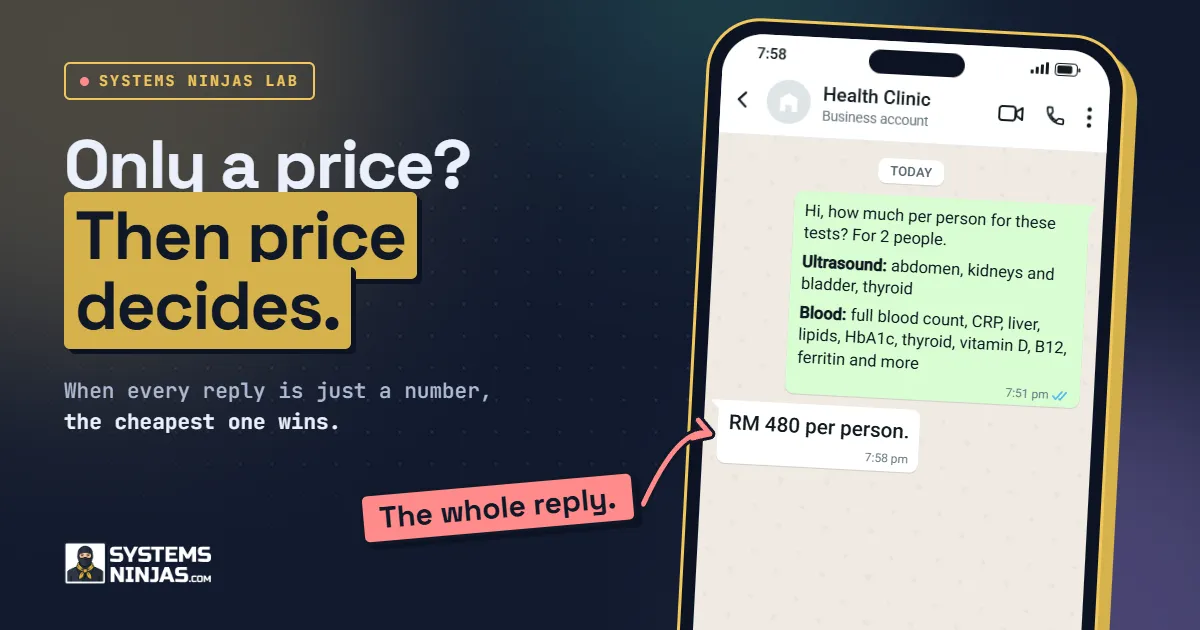
Everybody sounded the same. Every reply was a price, or no price. Nobody told me why I should choose them. Nobody said who reads the scan, how experienced that doctor is, what awards they have, or what makes their clinic different. The closest anyone came was a line saying a radiologist checks the report. Said as a line item, not as a reason.
So I was just comparing prices.
When everyone looks the same, the one with the lowest price closest to home wins.
Part 2What it costs the business
I will not give you an industry statistic, because I do not have one and most of the ones going around cannot be traced to any real data. Here is the cost in my own numbers, and a way to count yours.
The silent ones lost their share outright. 4 businesses had no person reply to me by noon the next day. My whole budget was RM 3,000 to 5,000 (about USD 750 to 1,200), and each of them could have won part of it. By the time anyone at those 4 reads my message, I have already been talking to someone else for a whole evening. They will never see it as a loss. There is no missed call on a list and no angry review. Just a chat that went quiet.
The price-only ones made themselves a commodity. A commodity simply means your price can be compared directly with everyone else's in the market. Petrol is a commodity. Rice is a commodity. Nobody asks which petrol station has the most caring pump. When every reply is only a price, you have done that to yourself: you have handed the customer a spreadsheet with one column. Two of the lists I got were about RM 600 per person apart (about USD 150) for the same set of blood tests. With nothing else to compare, that gap decides it. A business that cannot tell me why it is worth more has to be the cheapest, or lose.
The slow ones pay for the job twice. The clinic that pasted a chatbot answer did the right thing, slowly, by hand. Someone sat there, copied the list into a chatbot, copied the answer back, and sent it. That is a person doing a machine's job, an hour and a half late.
Count your own. Take one week. Count the price enquiries that came in after hours or on the weekend. Count how many got a real answer, with a price, before the next morning. Multiply the ones that did not by your average sale. One lost customer like me is RM 3,000 to 5,000 (about USD 750 to 1,200). You do not need a big number of misses for this to be the most expensive thing in your business.
Wider viewThis is not about clinics
I happened to be buying blood tests. Picture the same two mistakes in businesses that have never seen a lab report.
- Imagine a plumber. "How much to replace a leaking pipe under the kitchen sink? The house is about ten years old." The reply: "Hi! Thanks for contacting us. Our services: 1. Plumbing 2. Electrical 3. Aircon. Please choose a number." The customer asked a specific question and got a menu.
- Imagine a cafe. "Can you do a nut-free birthday cake for 20 people, pickup on the 14th?" The reply: a PDF of the full menu. The answer might be in there. The customer has to go and dig for it, while the cafe down the road just says yes.
- Imagine a salon. "How much for colour on shoulder-length hair?" The reply: "From RM 180" (about USD 45). Now the customer is comparing "from" prices across five salons, and the cheapest "from" wins.
Three made-up examples, the same two mistakes. A specific question gets a generic answer. And the answer, when it comes, is only a price. That is the whole recipe for becoming a commodity, and it works on any business.
The way out is your process. A competitor can match your price in one afternoon. They cannot match the way you work. Who does the job, how experienced they are, what they check that others skip, what happens after you pay. That is the part that cannot be lined up in one column. It is one of the oldest lessons in advertising: describe your process in plain detail, even if everyone else does the same thing, and the customer starts to see you as the one who does it properly. A few mentioned a piece of it, a radiologist's report or how long results take, but always as a line item. None of the 12 used their process as a reason to choose them.
Part 3What we would do instead
Here is my honest view, and it is not the popular one: I would not try to fix this with better staff.
There is no reason for a human to sit there until a human is actually needed. Every question I asked that evening could have been answered quickly and correctly by a well-trained bot. Is tax included? Is the report included? Is there a price for two? Do you do this test? None of that needs a person. It needs the right information, ready.
The people I talked to were not the problem. They were missing information. Think about how much someone has to know to answer my list properly. That a hormone test and a genetic test are different things, at very different prices. That two blood markers with similar names measure different substances. That is specialist knowledge. Most front desks are never given it, and nobody can be expected to carry it in their head.
I know this from the other side. At one point in my life I did marketing in the health industry, and people asked me questions. Truth be told, my understanding of the topics was never as deep as a doctor's... or as deep as a well-trained bot's can be now. And that is the trap. A front desk without the full picture is tempted to pick the closest thing it knows and say it with confidence. At best, the customer is annoyed. At worst, they pay a lot of money for something that is not what they need. One of my 12 priced a test I never asked for, at about three times what another clinic charged for the one I wanted. A customer without medical training has no way to tell.
A specific question deserves a specific answer. If I send a list of tests, the first reply should be about my list. Not a greeting, not a menu, not opening hours. And there is no technical reason it cannot be. Most of what I asked is what any clinic hears all the time. The only thing standing between a specific question and a specific answer is whether someone sat down once and prepared the answers in advance. If that has not been done yet, it is a one-time job.
So this is what we would set up, step by step. The example is a clinic, but every step works the same for a plumber, a cafe or a salon.
- Prepare the answers once. Every price, what each one includes, how long it takes, and what you do NOT offer. Written down once, in plain words, and kept up to date.
- Let a well-trained bot take the first reply, and make it an answer. It reads what the customer actually asked and answers that, in the first minute, at 9 pm on a weekend. If it needs one detail to give a price, it asks for it, in the same message.
- Ask everything you need in one go. If you need age, area or the reason for the test, ask all of it at once. Three round-trips of five minutes each is how a customer drifts off to another chat.
- Say what you cannot do. If a test is not on your menu, say so. Never swap in a different test with a similar name. The customer cannot tell, and when they find out, you lose their trust.
- Put your process and your people next to the price. Who reads the result, how many years, any special training, and what happens after the results. Even if your tests are the same as everyone else's, your doctor is not. This is the step that stops you being a commodity, and nobody in my 12 used it as a reason to choose them.
- Be patient with question ten. A customer asking a lot of questions may be the one closest to buying. I was. A person at a busy front desk gets tired. A well-trained bot does not. For a bot, my tenth question is just another day in the office.
- Bring in a human when a human is needed. Anything that needs a doctor's judgment, a special case, an unhappy customer. That is where your people are worth their time. Then ask for the booking: two real time slots and what to do before coming in.
The artefact: the one reply. Here is what a prepared front desk, human or bot, could have sent in the first few minutes. The blanks are where each clinic's own facts go. Notice that the reasons to choose the clinic sit right next to the price.
Hi, thanks for sending the full list! Here is everything in one go, for both of you.
Who will look after you: your scan is done and read by Dr ___, consultant radiologist, ___ years in practice, [award or special training]. After your results, Dr ___ goes through every number with you, face to face. That is included, not an extra.
Ultrasound (abdomen, pelvis, thyroid): RM ___ per person, signed report included, same day.
Blood tests: we can do ___ of your ___ tests here, RM ___ per person. ___ more go to our partner lab (+RM ___, results in ___ weeks). ___ we do not offer, and we will not swap in a different test.
Total for two: RM ___, tax included. [Any offer for two people.]
We have a slot on [date] at [time] or [time]. Please fast for 8 hours before. And ask me anything else, as many questions as you like.
That one message does five jobs. It gives the price and splits the list. It admits what the clinic cannot do. It says who sits behind the result. And it asks for the booking. Nobody I asked sent all five in one message.
The same shape works for any business. A plumber's version: "Replacing that pipe is usually RM ___ including parts, about an hour. Our plumber ___ has ___ years on older houses and checks the other joints while he is there, at no extra cost. I can send him on [date] at [time] or [time]." Price, process, person, booking. Four lines, and you are no longer just a number in a comparison.
I have not booked yet. But I know whose WhatsApp I will open first.
Part 4Results
Results: if a clinic runs this, the before-and-after numbers go here.
How I counted. Every time comes from the timestamps on my own WhatsApp. All 12 enquiries went out on one weekend evening, 2026-10-24, between about 6:45 pm and 8 pm, each asking about the same tests (the scan, the blood list, or both, depending on what that business offers). A "real person" reply means a message that responded to what I asked, not a template. I checked who had replied at noon on 2026-10-25. The businesses are not named, on purpose: this is one customer's experience, not a ranking, and every one of them may do better on a different day.
Ringgit amounts are converted at about RM 4.08 to 1 US dollar (rate read on 2026-10-25) and rounded, so treat the dollar figures as rough.
Uldis Zalcmanis (2026). Up to USD 1,200 was on the table. Not one of 12 businesses told me why to pay more than the cheapest. What Would Systems Ninjas Do?, Episode 1. Systems Ninjas Lab. systemsninjas.com/post/clinic-whatsapp-price-replies
Take any of it. You do not need to ask. If you find an error in here we would rather hear about it than not, and the correction goes on the page.
Want a front desk that answers like the one reply above?
This is the kind of front desk we build, for clinics, trades, cafes and anyone whose customers ask before they buy: a WhatsApp assistant that knows your prices AND what makes you worth choosing, and hands over to your people the moment a person is needed.
See what we build
Uldis Zalcmanis aka Systems Rockstar
Founder, Systems Ninjas · Kuala Lumpur
I build the automation and AI systems businesses actually run on, and I am the person who gets called when one of them quietly stops working.