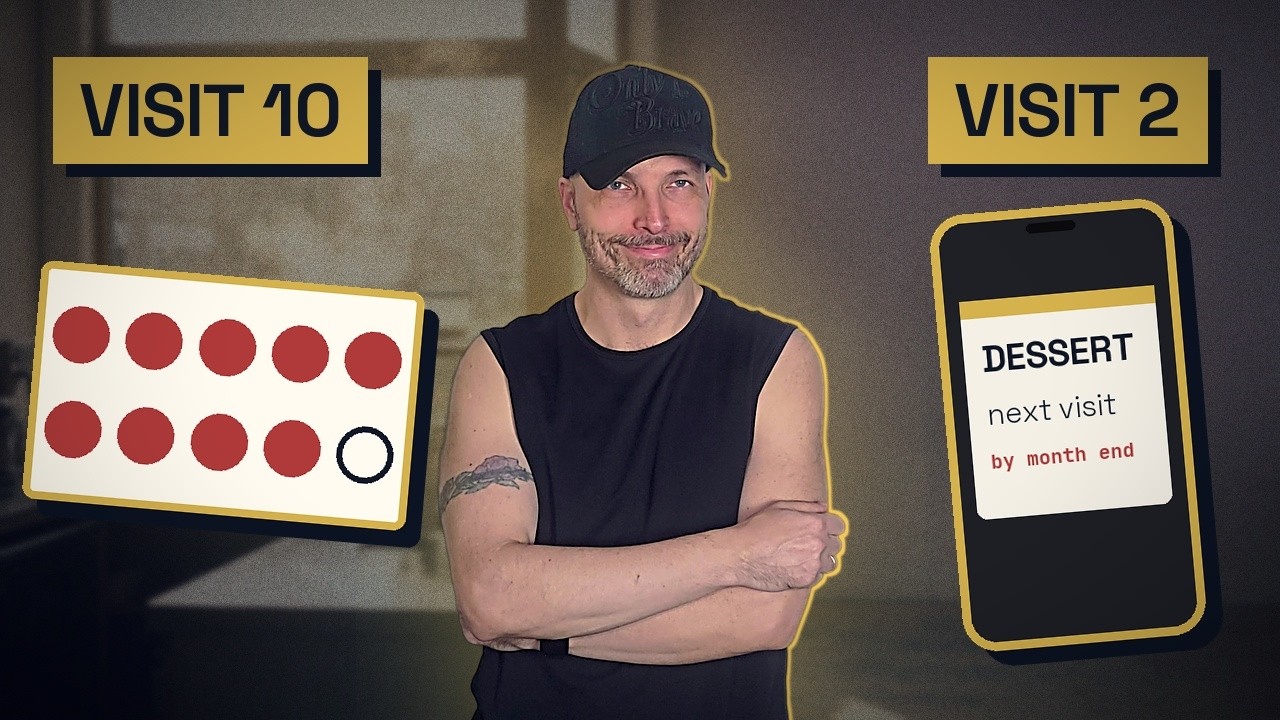
The Free Meal You Never Needed To Give Your Best Customers
Free checklistFrom the video
The free meal you never needed to give your best customers.
One A4 page. Put it next to your stamp card or your loyalty program and tick each line honestly. No email needed. Free to print and share, as long as you keep the Systems Ninjas credit on it.
Buy nine, get the tenth free pays the regulars who were coming anyway. That is the uncomfortable part about most loyalty cards. For a lot of restaurants, the card does not bring anybody new back.
Below there is a one-page checklist. 7 lines. Tick them against whatever you run today, a paper stamp card, a points app or nothing at all.
The dateIf you dated the way a stamp card runs a restaurant
Imagine you ran your love life the way a stamp card runs a restaurant. First date. Lovely evening. At the end you say "thank you, see you again." No number. No plan. Nothing.
Second date, if it happens: nothing. Third, fourth, fifth: nothing. And then on the TENTH date, you finally do something nice. You buy them a coffee.
So who is still around on date ten? The people who were already in love with you. They would have stayed anyway. Everybody else left after date one, and you never even asked for their number.
That is a stamp card. Buy nine, get the tenth free. It is a reward for people who already decided to stay.
Who it paysA discount for your best customers that you never needed to give
I have read the same complaint from restaurant owner after restaurant owner, in almost the same words. It just rewarded the regulars who were coming anyway. It did not bring in anybody new. After a year, they switched it off.
And they are right about what happened. The guest who comes every week fills a card in a couple of months. They get a free meal for doing exactly what they were already doing. That is not marketing. That is a discount for your best customers that you never needed to give.
To be fair, some owners LOVE their stamp cards. And the reason they give is that people rarely redeem them. Think about that for a second: a program you like because nobody uses it. So if your regulars do not need it and nobody else uses it, who exactly is it for?
The first-timerOne stamp, nine to go is homework
Look at where a stamp card starts. One stamp. Nine to go. For a first-time guest, that is not an invitation. That is homework.
The first visit was the hard part, and your marketing already paid for it. The ad. The walk past. The friend who said "you have to try this place." They came. They ate. And they walked out with "see you again."
The second visit is where a guest turns into a habit. And it is the visit hardly anybody designs for. So flip it.
The checklist7 lines for a reward that brings people back
-
1The reward starts at the first visit, not the tenth.
Give a first-time guest something to use on their NEXT visit. Not a stamp that needs nine more visits. One thing they can actually use when they come back.
If your current card only pays out at the end, this line is a no, however generous the end is.
WhyThe second visit is where a guest turns into a habit. A reward at visit ten speaks to people who already decided to stay. A reward at visit one speaks to the person who has not decided yet.
-
2It is small and specific.
It does not need to be big. A dessert on their next visit. Their first drink. Something that makes the second visit feel like it was planned for them.
A free main course is a lot of margin to hand to someone you have met once. Small and specific beats big and vague.
WhyThis is where it is easy to overspend. The point is the invitation, not the size of the gift.
-
3It has their name on it, and a date.
Not "anytime". A date. "The dessert is on us next time, before the end of the month."
WhyA reward with no deadline is a reward people mean to use and forget. A name and a date make it feel like it was meant for them, now.
-
4It is about coming BACK, not about spending more.
"Spend this much, get that much off" is a sum. "The dessert is on us next time" is an invitation. Check your own offer: is it asking them to return, or asking them to spend?
WhyPeople do not come back for sums. They come back for invitations. Point the reward at the behaviour you actually want: a second visit, or a regular coming back after going quiet. Not people doing what they already do.
-
5It lives in their phone, with no app to download.
Not a paper card that goes through the wash. Not an app they have to download for one coffee. A card that lives in the phone's own wallet, Apple Wallet or Google Wallet: one tap, no download.
WhyA small enough ask is one people say yes to. And when they say yes, you finally get the thing the stamp card never gave you: their name, and a way to reach them.
-
6Someone notices when a regular goes quiet.
Every regular has their own rhythm. When the weekly one disappears for three weeks, something happened. When the special-dinner couple disappears for three weeks, they are right on schedule.
When you do reach out, it does not have to be a discount. Often it should not be. "Have not seen you in a while. Your usual table is free this week if you fancy it." That is it.
WhyA regular does not need a coupon to feel missed. Often they come back simply because somebody noticed they were gone. A stamp card just sits in a drawer. It does not notice anything.
-
7You only offer what you can afford to give FOREVER, and nothing that spends your margin (the money you keep) runs without your yes.
Start small. You can always add more. Taking away is the expensive direction.
And whatever system you use, ours included, anything that spends your money should need your yes. Once. Before it runs. I have read about owners finding big discounts going out on orders, switched on by default by their software, and nobody asked them.
WhyThis is the trap in the next section. Taking a reward away feels worse to people than never having it, so a program that starts too generous ends worse than no program at all.
The trapThe most expensive mistake is the fix, not the stamp card
Here is a story I have read from owners more than once. An owner starts a loyalty program. It is generous. Too generous. Free things everywhere.
After a while they look at the numbers and think: we are giving away way too much. So they cut the rewards back. And the guests get ANGRY. Taking a reward away feels worse to people than never having it.
So the owner ends up worse off than if they had never started. They paid for a year of free coffee, and then paid again in bad feeling.
- Only offer what you can afford to give forever. Start small. You can always add more.
- Point the reward at the behaviour you want. A second visit. A regular coming back after going quiet. Not people doing what they already do.
- Nothing that gives away your margin runs without your yes. Once, before it runs.
Back to the dateAsk for the second date at the end of the first one
Stop waiting for date ten to be nice. Ask for the second date at the end of the first one. Get their number. Notice when they go quiet. And never promise anything you will have to take back.
A guest thinking about coming back usually sends a message first: "Do you have a table tonight?" If that lands at 11 at night and nobody answers, all of this falls apart at the door. That moment has its own write-up: Reply While You Sleep: 7 Checks For Your WhatsApp Inbox.
If you want to know which regulars are about to go quiet, RFM Analysis For Small Business shows how to spot them from your own customer list.
Want to see a come-back system for your restaurant?
That is what we build at Systems Ninjas: a card in your guest's Apple Wallet or Google Wallet that rewards the second visit, gives you a way to reach them again, and notices when a regular goes quiet. Ask the assistant on our site.
See what we build
Uldis Zalcmanis aka Systems Rockstar
Founder, Systems Ninjas · Kuala Lumpur
I build the automation and AI systems businesses actually run on, and I am the person who gets called when one of them quietly stops working.