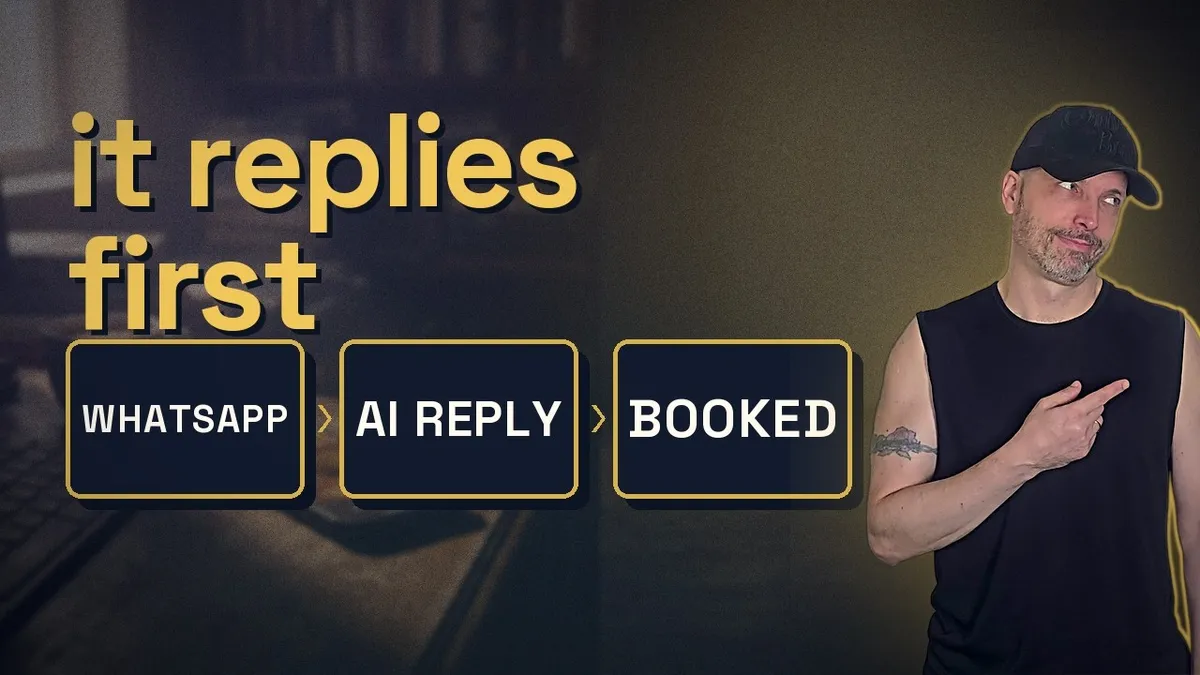
Reply While You Sleep: 7 Checks For Your WhatsApp Inbox
Free checklistFrom the video
Reply while you sleep: 7 checks for your WhatsApp inbox.
One A4 page. Go through it with your phone in your hand and be honest about who really answers your customers at night. No email needed. Free to print and share, as long as you keep the Systems Ninjas credit on it.
There's a belief spreading fast among business owners: I just need to be more responsive.
It sounds reasonable. It sounds responsible. It's also wrong. Being more responsive is not a strategy. It's a hamster wheel. You can run it faster and faster, and all you get for it is a sore thumb and a phone that won't leave you alone at dinner.
The businesses that win on WhatsApp, Instagram DMs and Facebook Messenger are not the ones with the fastest fingers. They are the ones who built a system that answers while they are doing literally anything else. Here are 7 checks that show which one you have.
11 PMSame message, two owners, two different mornings
In the video I tell this through my two characters. Pickleson runs his pizza shop on chaos, hope and prayer. The Systems Ninja runs his on systems.
At 11 PM a potential customer sends the same message to both: "Hey, do you do catering for corporate events?"
Pickleson sees it at 8 AM the next morning. He types a reply. By then the customer has already booked somewhere else. Not because his food is worse. Not because his price is wrong. Because someone else was faster.
The Systems Ninja's AI employee saw the message at 11 PM and answered straight away. It asked the right questions and collected the details. By the time he woke up, there was a catering enquiry waiting for him with the details filled in, half processed, ready for him to close.
Same customer. Same message. Completely different outcome. And the difference had nothing to do with how hard either of them works.
Not your faultTrying harder works for a week or two
I need you to hear this: it's not your fault. You have a business to run, staff to manage and a hundred things pulling at you. You cannot sit there and answer every message the moment it lands. That's called being human.
So what do most owners do when they notice they are missing messages? They try harder. They check the phone more often. They ask a staff member to watch it. They turn notifications up to maximum. And for a week or two it works. Sort of.
Then reality wins. Humans get tired. Humans get distracted. Humans go to lunch. Humans have bad days and reply a little sharper than they meant to. That's not a people problem. It's a system problem, because the system is making a human the front line.
The 7 checksWho really answers your customers?
-
1Your phone is not the front line. A system answers first.
Look at what happens to a new message today. If the honest answer is "it waits until I or someone on my team sees it", then a human is the front line, and the business slows down every time that human eats, sleeps or has a busy afternoon.
WhyNo human being should be the front line of their own business. Being human is not the problem. Building the business around a human's attention is.
-
2A message that arrives at 11 PM gets answered at 11 PM.
Not "we'll reply in the morning". A real answer, at night, that asks the right questions and collects the details, so a ready-to-close enquiry is waiting for you when you wake up.
WhyIn the story, nobody lost because of price or food. One owner lost because someone else was faster, and the other one was asleep too. His system wasn't.
-
3The routine questions get answered without you.
What are your hours? How much does it cost? Do you deliver? Can I book for this weekend? Write down the questions you answer over and over. Those are the bot's job.
WhyNone of these questions need your best people. They just need a fast, accurate, friendly answer, and that is exactly what a properly built AI employee gives.
-
4When a customer really needs a human, there is a clean handoff.
The bot knows when a conversation gets complicated, and it passes it on: to the right person, at the right time, with the details already collected. You step in only where a real human touch is needed.
WhyThat is the shift. AI handles the routine stuff, people handle the human stuff. It's how you keep customers happy and your brand safe.
-
5If someone asks "are you a real person?", it tells the truth.
It says it is AI. No tricks, no pretending. Test this yourself before your customers do: message your own bot and ask it straight. Some places also expect a bot to say it is AI in its very first message, without being asked: see do you have to tell people they are talking to an AI.
WhyAI can be built badly. Honesty is part of building it right, and when you build it right, people don't just accept the AI. They like it and they trust it.
-
6It talks the way your customers talk.
Their language, their style, their slang. Here in Malaysia people mix English and Malay in a very natural way. We call it Manglish. It's not an official language, but a well-built bot can speak it.
WhyWhen the customer feels like they're talking to someone local, someone who gets them, trust builds fast. And trust keeps customers.
-
7Its tone is friendly every single time.
The tenth identical question gets the same warm answer as the first. That's a choice you make when the bot is built, and it's worth checking: read a few real conversations and look at the tone, not just the facts.
WhyHumans have bad days and reply a little sharper than they meant to. A bot doesn't, unless you build it that way. I once made a mean version of one of our bots just for fun. It was funny to watch, but customers started dropping fast. That was a short experiment.
Not just WhatsAppThe platform changes. The problem doesn't.
I'm based in Malaysia, so that's where my direct experience comes from. Here WhatsApp is not just an app. It's THE channel. People message businesses the same way they message their friends: casually, quickly, and with a very clear expectation of speed.
But this isn't a Malaysia problem. Wherever messaging apps dominate, the same rules apply. And where WhatsApp is less common, the same pattern plays out in Instagram DMs, Facebook Messenger, or whatever channel your customers prefer. Run the 7 checks on every channel you answer, not just the busiest one.
Why nowYour customers are being trained by someone
The businesses that build this first are setting the expectation in their market. Once a customer has had a proper answer at night, going back to waiting hours for a reply feels unacceptable. You want to be on the right side of that shift.
On telling customers they are talking to a bot, we wrote up whether you have to disclose an AI chatbot. And for what happens after the first reply, when people go quiet, watch Automated Customer Follow Up: Why One Message Is Not Enough.
Want a bot that answers at 11 PM?
That is what we build at Systems Ninjas: AI employees that answer the routine questions on WhatsApp, Instagram and Messenger, are honest that they are AI, and hand the real conversations to your team.
See what we build
Uldis Zalcmanis aka Systems Rockstar
Founder, Systems Ninjas · Kuala Lumpur
I build the automation and AI systems businesses actually run on, and I am the person who gets called when one of them quietly stops working.