Good Food Earns A Second Chance. It Does Not Earn A Second Visit.
Free score sheetFrom the video
Good food earns a second chance. It does not earn a second visit.
One A4 page. Print it, grab a pen, and score your restaurant out of 10. No email needed. Free to print and share, as long as you keep the Systems Ninjas credit on it.
Most owners think customers come back because the food was good. That is wrong. Good food earns you a second chance. It does not earn you a second visit.
If guests are not coming back, it usually is not the food and it is not the price. It is that nobody gave them a reason. And nobody noticed when they stopped.
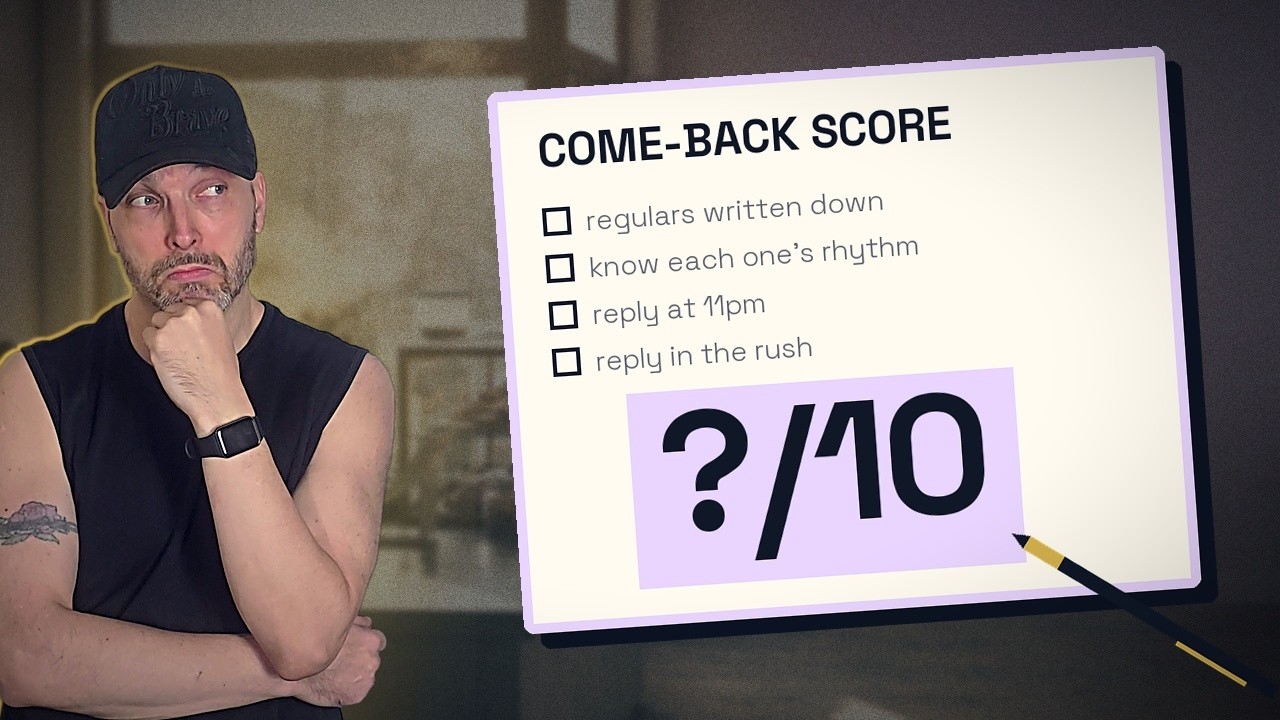
So score your restaurant on exactly that. Ten yes-or-no questions: five on getting customers to come back, five on answering the people who contact you. Then you will know which NO to fix first.
The one ruleHow to score honestly
Grab a pen, or just count on your fingers. One rule for scoring: tick YES only if it is true TODAY, on most days.
"Sometimes" is a no. "I think so" is a no. "My manager says we do that" is a no until you have seen it yourself.
Ten plantsThe cactus and the fern
Before the first question, picture this. You have ten plants at home, and you are very organised. Once a week, same day, you water every single one of them. Same amount. Very fair.
A month later the cactus has drowned, and the fern has died of thirst. Fair is not the same as right.
Every plant has its own rhythm, and so does every guest. A weekly lunch regular not seen for two weeks? Worth a look. A couple who come for a special dinner every few months? A month without them is nothing.
So one rule for everybody, "if we have not seen them in a month, send them something", is watering the cactus and the fern on the same day. Three of the ten questions depend on this.
The come-back score10 yes-or-no questions
-
1Are your regulars written down somewhere, by name or phone number?
Not in your head. Not in your best waiter's head. Written down.
If your list lives in one person's head, that is a NO.
WhyThe person who knows every regular by name, "the usual, no ice", one day hands in a resignation letter. And all of that walks out of the door with them. Nobody wrote it down, because nobody needed to. Until now.
-
2Do you know how often EACH regular usually comes?
Not "our regulars come about once a month." Each person. One comes every week. Another comes every six weeks. That is their rhythm.
If you take bookings, that rhythm is often already in your booking history. Sort it by person instead of by date, and suddenly you can see it.
WhyThis is the cactus and the fern. You cannot notice a change in a rhythm you never knew.
-
3When a regular is LATE compared with their own rhythm, does anyone notice before they are gone for good?
Late compared with THEIR rhythm, not yours. A weekly regular who has been gone three weeks: something happened. Maybe they moved. Maybe they had a bad night with you and never said. Maybe a new place opened down the road.
WhyYou do not know yet, but you still have a window to find out. Wait three months and that window is closed.
-
4Do you have a ready way to invite a missing regular back?
Ready means before you need it. A short message, written on a calm day, in your own words: "Have not seen you in a while, we would love to have you back." And something small you are happy to give, again and again, without wincing.
If you have that ready, YES. If you would have to think about it on the day, NO.
WhyIf you only think about it on the day, you will do what everyone does under pressure: a big discount, to everybody, at once. And you pay for guests who were coming anyway.
-
5Does a first-time guest leave with a reason to come back?
Something they can actually USE on the next visit. A reason has their name on it, ideally a date on it, and it is still in their phone a week later, when they are deciding where to eat.
Why"Thank you, see you again" does not count. That is not a reason. That is a goodbye with good manners.
-
6A WhatsApp arrives at 11 at night: "Do you have a table for four tomorrow at eight?" Does it get a USEFUL answer within minutes?
An automatic "sorry, we are closed" does not count. They knew you were closed. That is WHY they messaged at 11.
WhyIf that guest waits until morning, there is a good chance they have already asked somewhere else. And a guest who cannot get an answer never gets the chance to become a regular.
-
7In your BUSIEST hour, does every WhatsApp and Instagram message still get a reply within minutes?
Not a quiet afternoon. In the rush, when every hand in the building is carrying a plate. This is the one most owners are sure they pass.
How to check, and it is a bit uncomfortable: scroll back through your last 20 messages, find the ones from the rush, and look at how long each waited. If that surprises you, it is a NO.
WhyBeing sure is not the same as having looked. The rush is exactly when nobody has a free hand to answer.
-
8Can guests book a table by message, at any hour, on their own?
Not "leave your number and we will call you back." On their own: ask, get an answer, get a booking.
And if it is something a person really should handle, a big group or a special request, it goes to your team with the whole conversation.
WhyYou know how call-backs go. You call, they are in a meeting. They call, you are in the rush. Phone tag over a table for four.
-
9Do your Facebook messages and your Google reviews get a reply within a day?
Reviews especially.
WhyA reply to a review is not really for the person who wrote it. It is for the next guest, the one reading it right now, deciding if they are coming.
-
10Do you ask EVERY guest for a review, as a habit?
Every guest. Not only the ones who look happy. Not only when somebody remembers.
WhyIf you only ask the happy-looking ones, your page shows two kinds of people: the few you asked, and the angry ones who did not need asking. Ask everyone, and your page starts to look like your restaurant actually is.
Your scoreAdd up your YES answers, out of ten
- 0 to 2: wide open. Every NO is a place where a guest can be lost without you ever knowing.
- 3 to 5: running on luck. Regulars come back when THEY remember you, not because you reminded them.
- 6 to 8: good, with gaps. Most guests are looked after. Your NOs show you exactly where the rest go quiet.
- 9 or 10: strong. Protect what you have built.
Fix orderWhich NO to fix first
If question 6 was a NO, start there. Nobody becomes a regular if they cannot even get an answer. The write-up Reply While You Sleep: 7 Checks For Your WhatsApp Inbox goes through that one in detail.
If question 6 was a YES, go back to question 1. Everything in part one sits on top of a list. No list, no rhythm. No rhythm, and nobody notices when the fern starts to droop. If you already have a customer list and want to see who is drifting, RFM Analysis For Small Business shows how.
If questions 9 or 10 were a NO, More Google Reviews, Fewer Public Complaints walks through asking everyone the same way.
One NO at a time. Not ten at once.
Question 5 againThe fix nearly everybody reaches for
When owners hear question 5, a reason to come back, nearly everybody reaches for the same fix. A loyalty card. Stamps. Points. An app.
For a lot of restaurants, that fix rewards the people who were coming anyway, and does nothing for the first-timer who never came back. The next video is about why, and what to build instead: Your Loyalty Program Rewards the Wrong Customers.
Want to talk your score through?
That is what we build at Systems Ninjas: a way to keep your regulars on a list, notice when one goes quiet, and answer every message at 11pm and in the rush. Message the assistant on our site with your score.
See what we build
Uldis Zalcmanis aka Systems Rockstar
Founder, Systems Ninjas · Kuala Lumpur
I build the automation and AI systems businesses actually run on, and I am the person who gets called when one of them quietly stops working.