
What An AI Receptionist Actually Costs To Run In Malaysia
The AI costs about one cent. The message costs six to eight times more.

Systems Ninjas (2026). Measured running costs of an AI chat receptionist in Malaysia. Unit costs read off live billing panels on 2026-08-04 and 2026-08-17; Meta Malaysia rates verified against the published rate card and the live pricing API on 2026-08-04 and 2026-08-06. systemsninjas.com/post/ai-receptionist-cost-malaysia
Take any of it. You do not need to ask. If you find an error in here we would rather hear about it than not, and the correction goes on the page.
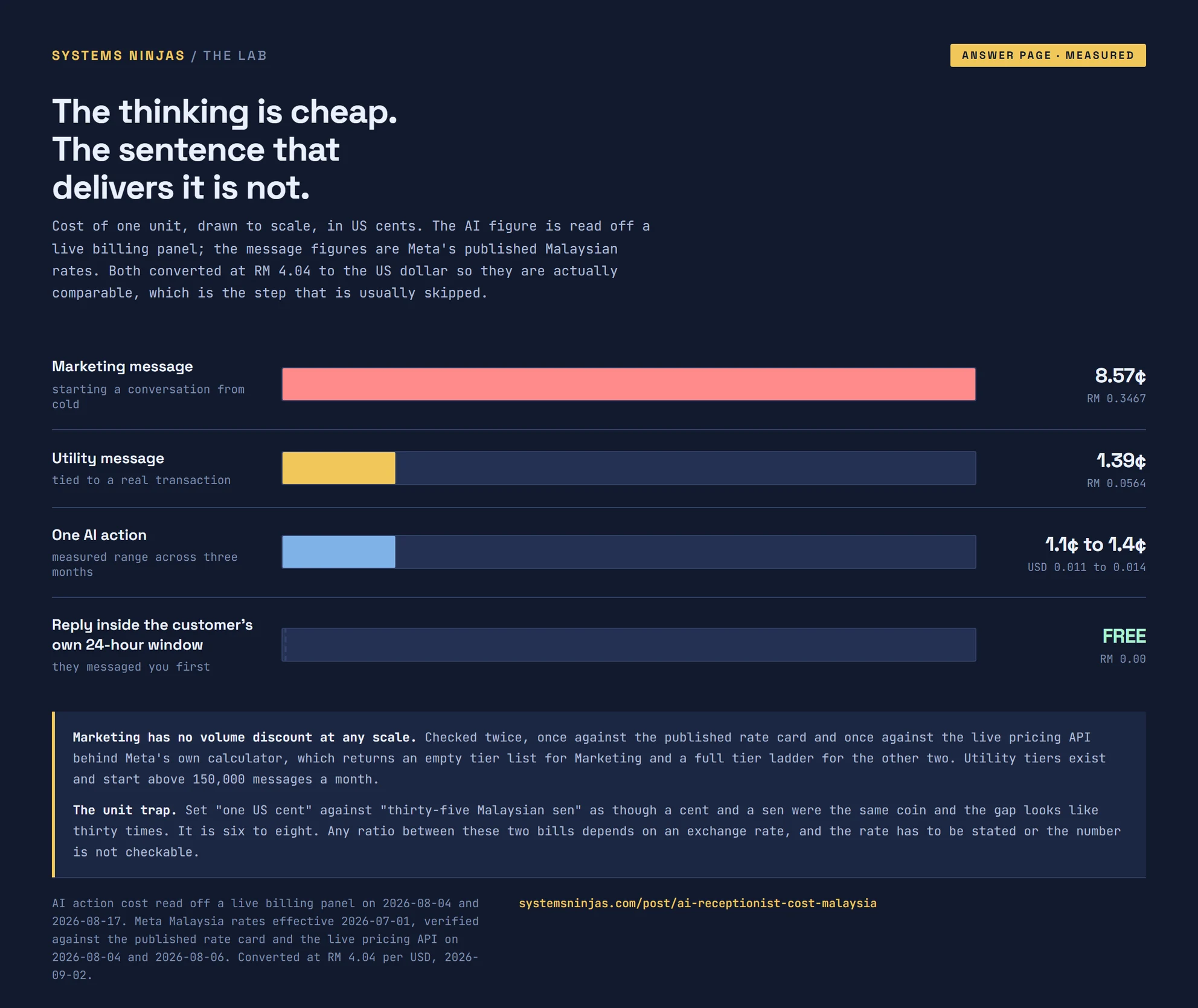
The intelligence is cheap and the messaging is not. On the accounts we run, the AI itself costs a bit over one US cent each time it acts. One marketing message on WhatsApp costs RM 0.3467. That is about eight US cents. So sending the message costs six to eight times more than the thinking that produced it.
That flip is the whole answer, and almost nobody quotes it that way round.
One warning before the numbers. This page nearly fell into this trap itself. The AI is billed in US dollars. The messages are billed in ringgit. So any comparison between the two only works once you turn one currency into the other. Every comparison below uses RM 4.04 to the US dollar, the rate on 2026-09-02. Put one cent next to thirty-five sen as if a cent and a sen were the same coin, and you get thirty times. That answer is four times too big.
The numbers below come off a live billing panel, not off a pricing page. We have also kept the estimate we got badly wrong, because the size of the mistake is the useful part. At the end comes the number that matters more than any of them. That is what it costs you to have none of this.
01 / Unit costsThe unit costs, measured
We read these off one live account's usage panel, over three months in a row in 2026.
| What | Measured meter cost | Note |
|---|---|---|
| One AI action | $0.011 to $0.014 | Rising across the three months |
| One WhatsApp utility message | $0.0155 | Flat, both months |
| One review-reply AI action | ~$0.011 | Identical both months |
These are meter readings, not a price list. This is what the usage itself costs, before anybody adds a margin, ours included. It is the wholesale price a shop pays, not the price on the shelf. Nobody sells it to you at cost. An agency that quotes you its own wholesale rate is either paying part of your bill this month, or has not read its own invoice. What you would actually pay is further down, under its own heading.
The second trap is the word "action". One billed AI action is not one customer message. A single back-and-forth with one person can set off several actions. So a bot handling a thousand conversations a month is not billing a thousand actions. Work out your size from the billing panel, never from a count of conversations.
02 / Our own errorWe estimated this and we were wrong by three to eleven times
Before we had a live account big enough to measure, we worked out a bot's cost on paper. We counted tokens, which are the small chunks of text an AI reads and writes. A few thousand tokens per exchange, so a fraction of a cent per message. That estimate was three to eleven times too low. And that is the smallest the error could be, not the full size of it. Our estimate was priced per MESSAGE. The measurement is per ACTION. As the trap above says, one exchange with one human sets off several actions. So putting the two side by side makes us look less wrong than we were.
The reason is built into how these bots work, so it applies to every live bot, not just ours. A real bot carries three things on every single call: a long set of instructions, a knowledge base, and the conversation so far. It re-reads all of it every time, the way you would re-read a whole file before answering one question about it. So most of the cost sits in what the bot reads, not in what it writes. The short, tidy question-and-answer the estimate assumed does not exist in real use.
So never work out a bot's cost on paper from token counts. Read the billing panel.
We also have to flag something against our own numbers. On 2026-08-14 the platform announced a cut of "up to 50%" to AI action costs. That date sits in the middle of the months these figures come from. We have not verified whether that cut reached the exact meter we read. So treat the AI column as a ceiling rather than an exact figure. The true cost could be lower.
03 / Meta's lineWhat Meta charges, which is the bigger line
Malaysia switched to being billed in ringgit on 2026-04-01. The rates below started on 2026-07-01.
| Category | Per message |
|---|---|
| Marketing | RM 0.3467 |
| Utility | RM 0.0564 |
| Authentication | RM 0.0564 |
| Service (a reply inside the customer's own 24-hour window) | Free |
Marketing has no volume discount. At any scale. This is the line most often got wrong in a proposal. We checked it twice. Once against Meta's published rate card, and once against the live price feed behind Meta's own calculator on its site. For Marketing, that feed comes back with no discount tiers at all. For the other two message types, it comes back with a full ladder of them. Utility messages do get discount tiers. They start above 150,000 messages a month, which no small or medium Malaysian business is going to reach.
A quoted Marketing price is the price you pay. Send one broadcast to a thousand Malaysian numbers and Meta's fees alone come to about RM 347. Send it to twenty thousand and it is about RM 6,934. That is a floor. Nothing brings it below that.
These are Meta's own published rates and they are the same for everyone. They are also the only numbers on this page with nobody's markup added on top.
04 / A real monthWhat a real month looks like
Here is one live account we run, over three months in a row, with everything included:
- Month one: $72
- Month two: $134
- Month three: projected at roughly double month two, worked out from part of a month. The first two figures were measured. This one is arithmetic on a month that had not finished, and we label it that way on purpose
Read the shape of this, not the exact totals. Two things drive it. First, the AI bill grew faster than the message bill. More conversations do not only mean more conversations: they mean more actions inside each one. Second, and more usefully:
The messaging bill grew far more slowly than the traffic. Volume went up about 4.4 times. The messaging bill went up about 1.4 times. So the average cost per message fell to roughly a third. Our best explanation is that as more people write in, more of the replies land inside the free 24-hour window, where a reply costs nothing. We measured the two ratios. The explanation is our reading of them, not something we measured.
That is the opposite of what most people expect, which is that a busy bot gets expensive fast. A busy INBOUND bot, one that answers people who wrote to you, gets cheaper per message. A busy OUTBOUND one, one that starts the conversations, does not.
05 / The bundle trapWhat you would actually pay
Everything above is what we measured. This is what we charge, and we would rather you read it here than find it in a proposal.
| What | Our price | What it is |
|---|---|---|
| Unlimited AI | USD 150 / month | Conversation, voice, reviews and content AI on the account, not metered per action |
| USD 50 / month | The WhatsApp channel, a unified inbox, a hardened bot on it, and the automation behind it | |
| Message and usage volume | At our published rates | Meta's per-message cost is Meta's. Our rate sits above it, like every provider's does |
Two honest notes on that table, because they are the questions we would ask.
The unlimited AI tier is not always the right answer. It only becomes the cheaper option above a certain volume. Below that, paying per use costs you less. It works like a phone plan: the flat monthly one wins only once you use enough. On one account we run, the crossover came in a particular month, and we moved it then, not before. Which side of that line you sit on has a number as its answer, and the number changes month to month.
And the middle bundle is the one to watch. Most platforms of this kind sell a middle tier with a set allowance of AI replies included. On the account above, that allowance would have covered an estimated 8% of what the account used that month. That 8% is worked out from part of a month, not from a full measured one, and we would rather say so than pass it off as a fact. The other 92% would still have been charged per use, on top of the monthly tier fee. So it is not really a ladder you climb. It is pay per use, then a step that can cost you money, then a step that saves you money.
That is the whole reason we quote either unlimited or pay per use, and nothing in between.
06 / The real ceilingThe cost of the answer that never came
Here is the number that should decide this. It is not on any invoice.
Uldis recently tried to book a table at a restaurant in the Klang Valley. The first reply said someone would get back to him after 2pm. He waited about four hours. When the conversation finally started, every question he asked meant another wait, because the person on the other end was fitting him in between other jobs. The dinner, for two, came to just under RM 1,000.
He went because he had decided on that specific restaurant. Almost nobody does that. Anyone with a second choice books the second choice inside those four hours.
Then the part that makes it worse. On the night, the restaurant was somewhere between 10% and 20% full.
So do the sums. One table, one evening, just under RM 1,000. Unlimited AI is USD 150 a month, which at the RM 4.04 rate above is about RM 605. That one booking was worth more than a whole month of the thing that would have answered him at 10am. Add the WhatsApp channel and that is another USD 50, about RM 202. The two together still cost less than that single dinner.
A restaurant with 80% of its tables empty cannot afford to lose the customers who are trying to hand it money. It was not losing them to a rival's food or price. It was losing them to a four-hour wait for a reply. That is a problem people solved a long time ago.
Read that as one story, because that is all it is. One evening, one restaurant, one person's bill. We are not going to dress it up as a statistic. We will not tell you that businesses lose some percentage of their enquiries to slow replies. The figures people pass around for that fall apart when you try to trace them to a source. We have written about that elsewhere. What the story is good for is the ratio, and the ratio is not close. It costs less per month to answer everybody, straight away, at midnight, in the language they wrote to you in, than one average sale is worth. That holds in most businesses with an average sale worth talking about.
So count your own. Take what an average sale is worth to you. Then count the enquiries last month that waited more than an hour for a first reply. Your inbox will tell you, and the answer is usually worse than people expect. You do not need to guess at a conversion rate, and you do not need a vendor's benchmark, to see whether this pays for itself. If winning back one booking a month covers the fee, the fee was never the real question.
07 / What to doThe thing that actually stops a big send, and it is not cost
If you are planning a big send, the thing that stops you is usually not the bill. It is whether the messages get delivered.
WhatsApp limits how many different people you can message. The limit belongs to your business portfolio, which is the account that holds your WhatsApp numbers. It counts unique recipients over a rolling 24 hours, so the window keeps moving instead of resetting at midnight. And it climbs in fixed steps: 250, then 2,000, then 10,000, then 100,000. On top of that, WhatsApp paces your sending, which means it slows it down. And on a poor quality signal, the rest of a bulk send can be dropped with no error at all. This has a name and a code, and neither one appears in the public pricing docs. Your messages sit in a queue marked held_for_quality_assessment. If the signal does not recover, every message still held there is dropped. What comes back is a webhook, an automatic status report from WhatsApp to your own system, carrying status: failed and error 135000. Look in your own webhook log for that code before you believe a send finished.
A budget that assumes 20,000 messages will go out in one day is not a budget problem waiting to happen. It is a delivery problem that looks like a budget.
08What we would tell you to do with this
Four things, in order.
- Work out what you are losing before you work out what you would pay. Multiply your average sale by the number of enquiries that sat unanswered for hours last month. If that number is not comfortably bigger than a few hundred ringgit a month, do not buy this, from us or from anybody. If it is bigger, the rest of this page is detail.
- Find your own numbers before you accept anyone's, ours included. Everything measured above comes from accounts we run, in one market, in one quarter of 2026. How much of your traffic you answer, against how much you start, will move your total more than any vendor's per-message rate will.
- Keep the two bills separate in your head. At the volumes a small or medium business runs, the AI is small change. The messaging is the real cost. The biggest single thing you can move is how much of your traffic gets answered inside the free 24-hour window, instead of needing a paid template to open a conversation.
- Stop pricing outbound messages as though they get cheaper in bulk. For marketing messages in Malaysia they do not. A proposal that builds in a bulk discount is building in something that does not exist.
The uncomfortable version: if the plan only works at 20,000 marketing messages a month, it costs RM 6,934 a month in Meta fees before anyone has replied even once. Nobody selling you the automation is going to open with that.
The more uncomfortable version, aimed at the buyer rather than the seller: the restaurant above is still doing it the old way tonight. That four-hour wait costs it more per empty table than the fix would cost per month.
We measured these figures against live billing panels on 2026-08-04 and 2026-08-17, and against Meta's published Malaysia rate card and its live price feed on 2026-08-04 and 2026-08-06. Our own prices are current as at 2026-09-03. Rates change on the first day of a quarter, with a month's notice. If you are reading this well after those dates, check before you use it.
We will size your own bill before you commit to anything
Tell us roughly how many conversations a month you expect, and how many of them you would be starting rather than answering. We will come back with the two bills separated, the free-window share that actually drives the total, and the tier you belong on. If the honest answer is that you do not need this yet, that is the answer you will get.
Size my bill [email protected] · No client of ours is named anywhere on this page, and if you become one, you will not be either.
Uldis Zalcmanis aka Systems Rockstar
Founder, Systems Ninjas · Kuala Lumpur
I build the automation and AI systems businesses actually run on, and I am the person who gets called when one of them quietly stops working. Born in Riga, based in Malaysia, father of two, and constitutionally unable to stop reading page source.
The Lab is where the measurements get published, including the ones that do not flatter us.