Turn Social Media Followers Into Customers: 7 Checks
Free checklistFrom the video
Turn followers into customers: 7 checks.
One A4 page. Pin it next to wherever you plan your posts and tick it off before the next one goes up. No email needed. Free to print and share, as long as you keep the Systems Ninjas credit on it.
Imagine this. One evening you post something on social media: a behind-the-scenes clip, a tip, something that took two minutes to share. By the next morning, people have commented one word on that post. By the afternoon, each of them has something sitting in their phone that connects them directly to your business. By the weekend, sales start coming in. And you didn't run a single ad.
That is not a fantasy. It is what happens when you understand one thing most business owners miss about social media.
Most small businesses on social media are trying hard and getting most of it right. But one missing piece decides whether all that effort turns into money, or just turns into content. Here it is, as 7 checks.
Borrowed attentionYour follower count tells you almost nothing
It feels logical. You built an audience, so surely they see what you share. But your followers belong to the platform, not to you, and the platform decides whether they see you today. That is fine as long as your competitors are in the same boat. The moment one of them starts building something they actually own, the game changes fast.
So stop asking how many followers you have. Ask one question instead: how many of these people can I reach directly, right now, without asking the platform's permission? That gap is where the money lives.
The mindsetSocial media is not where you sell
Social media is NOT where you sell. It is where you earn the right to have a private conversation. Nobody opens Instagram ready to buy. But they ARE paying attention, and attention is the first currency.
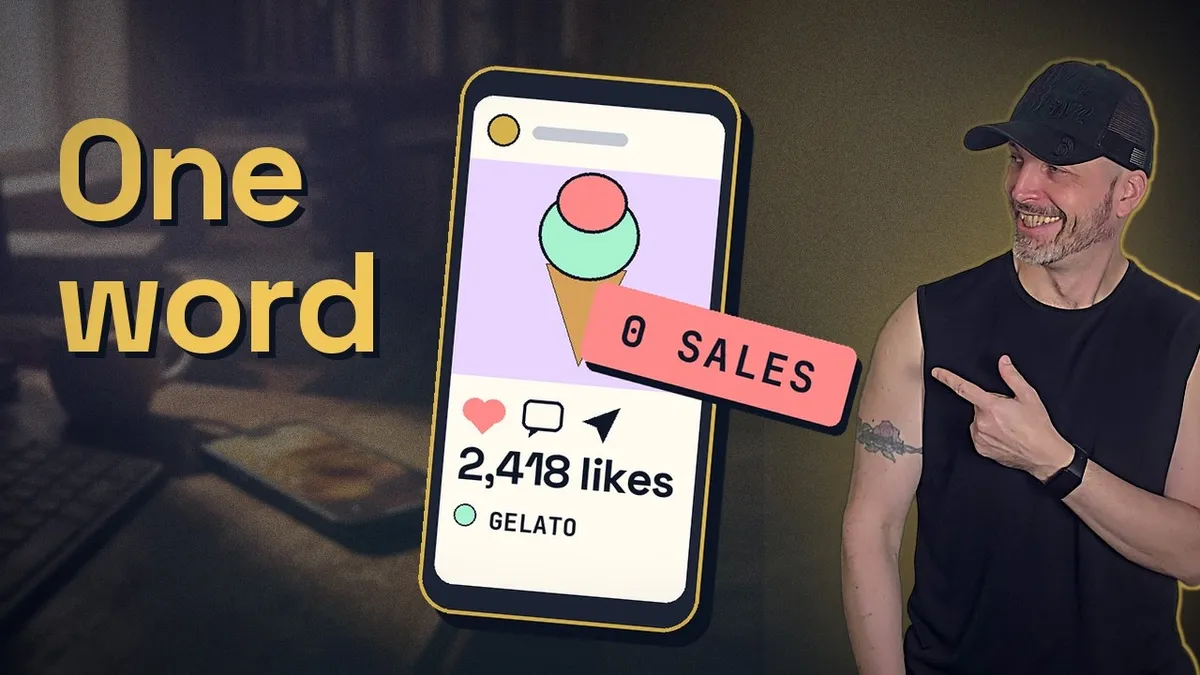
Businesses get this wrong in two opposite ways. One treats every post like a shop window with a SALE sign: every caption an offer. The audience learns to scroll straight past, because nobody wants to follow a business that makes them feel like a wallet with eyes. The other posts beautiful photos that get lots of likes and zero action. The feed looks amazing. The revenue doesn't.
The space between them is a stage. You educate, you entertain, and most of the time you give value with no strings attached. Then, now and then, you place a doorway.
The 7 checksFrom follower to someone you can reach
-
1You judge your social media by how many people you can reach directly, not by follower count.
Keep a second number next to your follower count: how many people you can message yourself, without a platform in the middle. That is the number to grow.
WhyFollowers belong to the platform, and it decides whether they see you today. People you can reach directly are yours.
-
2Most of your posts give value freely: teach, entertain, make people feel something.
Teach, entertain, make people feel something, with no strings attached, most of the time. In the rest, place a doorway: an invitation that leads somewhere private, like a DM.
WhyAll offers get scrolled past. Never asking gets likes and no action. Both extremes leave money on the table.
-
3Now and then a post carries a doorway, and the doorway leads to a private chat.
Not a hard sell. A doorway. And it doesn't lead somewhere public. It leads to a DM, a one-to-one conversation where the sale happens quietly, away from the feed, one person at a time.
WhyYou are not pitching in front of an audience. You are taking someone aside and helping them.
-
4You run comment-to-DM: a useful post, plus one line asking for one word.
Post something genuinely useful: a tip, a behind-the-scenes moment. In the caption, add one line like: "Comment GELATO and we'll send you a coupon for a free gelato on your next visit." The moment someone comments that word, an automated message fires into their DMs.
WhyThe conversation has already started, without you lifting a finger. If you only take one thing from the video, make it this.
-
5The gift saves straight into their phone wallet, not just an email address.
Offer something with immediate value, like a coupon or a first-visit gift, rather than a guide. The kind of coupon that installs into Apple Wallet or Google Wallet: they tap, fill in a few quick details, and the card is in their wallet. No app to download. No account to create.
WhyA guide usually captures an email address, and for local businesses selling to the public, email in my experience gets very little actual response. A card in their wallet is a direct line for reminders that lives on THEIR device.
-
6A message with no keyword still gets a real answer.
"Hey, what are your hours?" "Do you do catering?" "I saw your post, tell me more." A basic bot hits a wall here, because it is waiting for a trigger word it never received. A properly trained AI assistant reads what the person means, and in the ideal setup it also knows whether they are new or have been coming back for years.
WhyA first-timer gets a reason to show up: that's when the free gelato appears. A returning customer gets recognised and rewarded instead.
-
7You remind people before their coupon runs out.
Send the coupon. Then follow up as the deadline gets close, and remind them what they are about to lose. Once it is built, it runs for every contact, every time, without anyone managing it by hand.
WhyMost people who save a coupon never use it. Not because the offer was bad, but because life happened. Nobody sets a calendar reminder for a gelato coupon.
Three ways inThree ways to turn a follower into a contact you own
They work very differently, and they are not equally powerful.
- A QR code or a link in bio. "Scan this, get a discount." Simple, and it still works now and then. But people see it coming. It is the weakest of the three, because it is a transaction dressed up as content.
- Comment-to-DM. One word in the comments starts a private conversation and delivers the gift. Check 4 above.
- An AI assistant that reads intention, for everyone who messages you without the keyword (check 6). Behind it, what works best is a team: a boss that runs the conversation and specialists for coupons, bookings and orders. On the front it looks like one helpful person.
After the yesWhere most businesses drop the ball
Even businesses that set everything up correctly often stop here. The card is installed. The person said yes, I want that. And then nothing happens.
The majority of people who install your coupon will never claim it on their own. Their boss sent an urgent message, their kid needed something, and your coupon sat in their wallet quietly expiring. Still, compare it with a paper flyer or a stamp card: when that disappears, there is no reminder and no second chance. A card in someone's wallet still gives you their permission to talk to them.
Coupon use follows a predictable pattern: a spike when the coupon arrives, a lull, and then, if someone reminds them the deadline is coming, another spike right at the end. That second spike only happens if YOU send the reminder. We all postpone decisions that can be postponed, and later quietly becomes never.
Watch nextCapturing the lead is only half the job
The follow-up is where the money actually lives. The next video to watch is Automated Customer Follow Up: Why One Message Is Not Enough, on why most businesses stop too soon. And if you want to see what a well-built AI assistant can do, watch Why Your Business Chatbot Is Stuck at Level 1.
Want to see what a coupon in Apple Wallet or Google Wallet feels like?
That is what we build at Systems Ninjas: comment-to-DM, loyalty cards in the phone's own wallet, and the reminders that follow, so a follower becomes someone you can actually reach. Our demo restaurant's card is on our website, and you can add it to your own phone.
Try the demo card
Uldis Zalcmanis aka Systems Rockstar
Founder, Systems Ninjas · Kuala Lumpur
I build the automation and AI systems businesses actually run on, and I am the person who gets called when one of them quietly stops working.