
Why Your Form's Completion Rate Is Worse Than The Number You See
259 asked. 25 finished. 31 more believed they had.

Systems Ninjas (2026). False completions in a multi-step collector. Measured 2026-08-17 on a live four-step flow: 259 asked, 165 opened, 25 finished, 37 self-reported completion of whom 31 had no record. systemsninjas.com/post/multi-step-form-completion-rate
Take any of it. You do not need to ask. If you find an error in here we would rather hear about it than not, and the correction goes on the page.
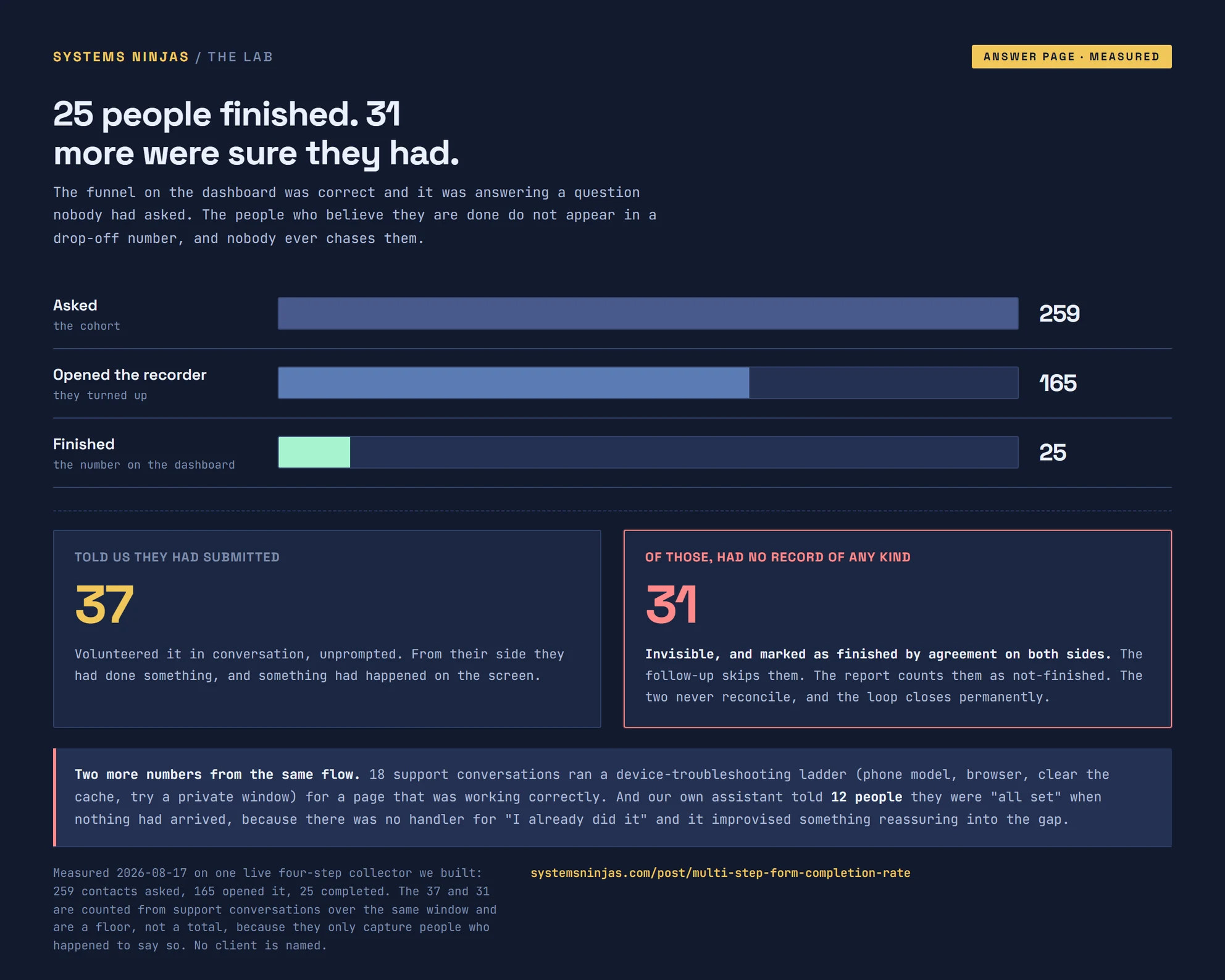
Because the people who think they finished are not counted as having dropped out. On a four-step form we built, 259 people were asked, 165 opened it, and 25 finished. Then 37 people told us they had sent it in. 31 of those 37 had left no trace on our side at all.
The 25 is the number on the dashboard. The 31 are invisible, and they are the ones that cost you money.
01 / When step 2 looks like step 1What happens when step 2 looks like step 1
Any form split across several screens can fail this way. So can a step-by-step wizard, a video recorder or an upload page. The failure has nothing to do with whether the technology works. It works fine. The person just cannot tell.
The person finishes step one. The page moves on. Step two looks almost exactly the same: same layout, same instructions, same button.
They do not think "next question". They think "it broke and made me start again."
From there they do one of two things, and both are bad:
- They give up, believing they already finished.
- They report a bug that does not exist.
We watched all three shapes of damage on the same flow.
The drop-off. 259 asked, 165 opened the recorder, 25 finished. So 140 people opened it and gave up.
Every bit of writing around it talked about one thing, not four: "a short video", "a minute or two is plenty", "a few short prompts". Nothing told them there were four steps except a small grey counter in the corner. Nobody reads that on a phone in the middle of doing something.
The faults that were not there. 18 support conversations worked through the usual list: phone model, browser, app version, clear the cache, wifi or mobile data, try a private window. All of it for a page that was working correctly.
That is 18 people left feeling their phone was the problem. Plus the staff hours spent walking them through it.
The people who thought they had finished. 37 said they had sent it in. 31 of them had left no record at all.
02 / The expensive oneThe false completion is the expensive one
Here is why, and it is the whole point of this page.
Someone who gives up is visible. They sit in your list of unfinished people. Somebody can look at them, and somebody can chase them.
Someone who thinks they finished is worse than invisible. They are filed as done. Nobody chases a person the system says has finished. The follow-up messages skip them.
Think of a queue where a few people believe they have already been served. They stop putting their hand up. Nobody calls their number. Everyone is satisfied and nothing has happened.
Your report has them as not finished. Your conversation with them had them as finished. Nobody ever puts the two side by side, so the gap never shows up. Both sides walk away sure the matter is closed.
And then our own bot made it worse.
03 / Our bot made it worseThe bot confirmed something it could not see
The assistant answering those conversations told 12 people they were "all set", that there was "no need to resubmit", and that "the team will review yours".
None of their submissions had arrived.
Here is the part that matters. Nobody had written those words into the bot's instructions. There was no bad rule to find and delete. There was NO rule.
Nobody had told the bot what to say when someone claims they already did it. So the bot made something up to fill the silence, which is what these models do. And what it made up was reassuring, because reassuring is what sounds right.
Adding an "if" does not save you. "If you recorded it on the page, you're all set" lands on a real person as a yes. They hear the second half of the sentence and let go of the first.
A bot must never confirm a completion it cannot verify. That is now a hard rule for us, and it applies to every assistant we build, on every channel.
04 / Three fixesThe three fixes, none of which are technical
1. State the shape in the body copy, not in a progress label.
"Three questions, one video each, then your details."
That belongs in the sentence people actually read, not in a small counter in the corner. A step counter is a progress indicator for someone who already knows there are steps.
2. Confirm the step that just COMPLETED, not only the one now due.
The missing "got it, one of three done" is the entire difference between an advance and an apparent loop. The system knows it happened. It just does not say so, because the developer is thinking about what comes next and the user is thinking about what just happened.
3. Name the final landmark, and let them answer.
This is the fix for the people who think they finished, and it needs no access to your records at all.
Do not ask "did you submit?" They will say yes, because from where they sat, they did something.
Ask: "Did you reach the Thank You screen?"
That is a question about something they saw with their own eyes. It costs one sentence, it needs no data at all, and it tells apart the people who finished from the people who only believe they did.
05 / For supportAnd for whoever answers your support messages
Assume the page moved on before you assume the phone is broken.
Ask about the phone model only AFTER they confirm they reached the end and it still failed. Asking earlier does two bad things at once. It makes a working page feel broken. And it teaches the customer that the fault is theirs, when it is not.
Eighteen conversations went the other way round on our watch.
06 / What we would redoThe thing we would do differently
Not the copy, and not the bot rule, although both are fixed.
We would have measured the gap between "people who say they finished" and "people who left a record" on day one. It takes five minutes to check. We ran it three weeks in, and only because something felt wrong.
Every number on that dashboard was correct. It was answering a different question from the one that mattered. The one that mattered is this: of the people who believe they are done, how many actually are?
Measured 2026-08-17 on a live four-step form we built. The group size is real, the client is not named, and every number here is one you could produce for your own form in an afternoon.
Run the five-minute query on your own flow
Count the people who told you they finished, then count the people who have a record. The gap is the number nobody has. Tell us what your flow runs on and we will write the query for your setup and send it over, so you can run it yourself without giving anybody access to anything.
Get the query [email protected] · No client of ours is named anywhere on this page, and if you become one, you will not be either.
Uldis Zalcmanis aka Systems Rockstar
Founder, Systems Ninjas · Kuala Lumpur
I build the automation and AI systems businesses actually run on, and I am the person who gets called when one of them quietly stops working. Born in Riga, based in Malaysia, father of two, and constitutionally unable to stop reading page source.
The Lab is where the measurements get published, including the ones that do not flatter us.