
Is The Five-Minute Lead Response Rule Real?
The five-minute study is real. It measured whether they picked up the phone.

Systems Ninjas (2026). Provenance trace of the five-minute lead-response claim and its family. Primary documents fetched and read 2026-09-01. systemsninjas.com/post/five-minute-lead-response-rule
Take any of it. You do not need to ask. If you find an error in here we would rather hear about it than not, and the correction goes on the page.
There is a real study, and the famous number is in it. What is not in it is the thing almost everyone says next. They say that answering in five minutes makes people buy from you. The study does not say that.
The study measured one thing: whether you got the person on the phone. Not whether they bought anything.
Picture yourself knocking on doors down a street. You can count how many people open the door. You can also count how many people buy something from you. Those are two different numbers, and one does not tell you the other. This study counted doors that opened.
It says so in its own words. Then it says several other things that nobody repeats.
01 / The documentWhat the document actually is
How Much Time Do You Have Before Web-Generated Leads Go Cold?, copyright 2007. A company that sells sales software published it. That company's boss presented it at a marketing conference in October 2007, alongside an academic.
The data behind it is genuine, and there is a good amount of it: three years, more than 15,000 leads, more than 100,000 call attempts. All of it came from the company's own customers, working on the company's own software.
Here is the line everyone quotes, word for word:
"The odds of qualifying a lead if called in 5 minutes versus 30 minutes drop 21 times."
That sentence is accurate. Here is what sits around it in the same document.
02 / Its own caveatsFour things the study says about itself
1. It did not measure sales. The document says so in plain words: "This study did not address close ratios."
A close ratio is the share of leads that end up buying. The study never looked at that.
The 21x number is about QUALIFICATION. That means you got hold of a real human and worked out that they were a genuine possible customer. It says nothing about money coming in. Every time you see "21 times more likely to convert", one word has been quietly swapped for another.
2. Half the research failed. The study had a second half: a survey of 495 companies. The authors report that they "couldn't find ANY statistically significant answers" from it.
In plain words, that half gave them nothing solid enough to stand behind. People still quote the study as though both halves worked.
3. You cannot see this effect inside one business. The document says the pattern shows up "only when data from several companies is combined".
So the finding is real once you pool six companies together. Think of a quiet song playing under a lot of noise. In one company's numbers the noise drowns it out. Put six companies' numbers together and you can hear it.
What a single business owner hears, that this will show up in YOUR numbers, is not what was measured.
4. The company that published it also sold the cure. From the document again: "This study caused a significant shift in our corporate positioning."
That does not make the numbers false. It does mean this is a sales document, written by a company with something to sell, rather than independent research. Anyone quoting it should say so out loud.
03 / Two wrong labelsTwo labels on it that are wrong
It is not MIT research. The academic who presented it alongside the boss held a Faculty Fellow position at MIT Sloan.
One of the authors having a job at a university does not make the work a university study. The paper was never peer-reviewed either, which means no independent experts checked it before it went out.
It is not Harvard Business Review. HBR published a different piece of research, with different numbers. A thousand blog posts have since welded the two into one.
If a page credits "Harvard" for the 5-minute and 21x figures, whoever wrote that page has read neither source.
04 / The family, tracedThe other numbers people quote, and where they come from
We went looking for the original source of each one. The original source is the document where a number first appeared, not a blog post repeating it. Here is where each trail ends.
| Claim | Where the trail ends |
|---|---|
| "78% buy from the company that responds first" | Attributed to a survey with no retrievable report, sample, method or date |
| "35 to 50% of sales go to the first responder" | Appears in no primary document from the company it is attributed to |
| "The average business takes 42 hours to respond" | Real, but it is a long-tail mean that describes almost nobody. See below |
A missing source does not prove a claim is false. It does mean you should keep the number out of a proposal. It also means that anyone who puts one in has not checked.
05 / The one to citeThe study worth quoting, and how to quote it honestly
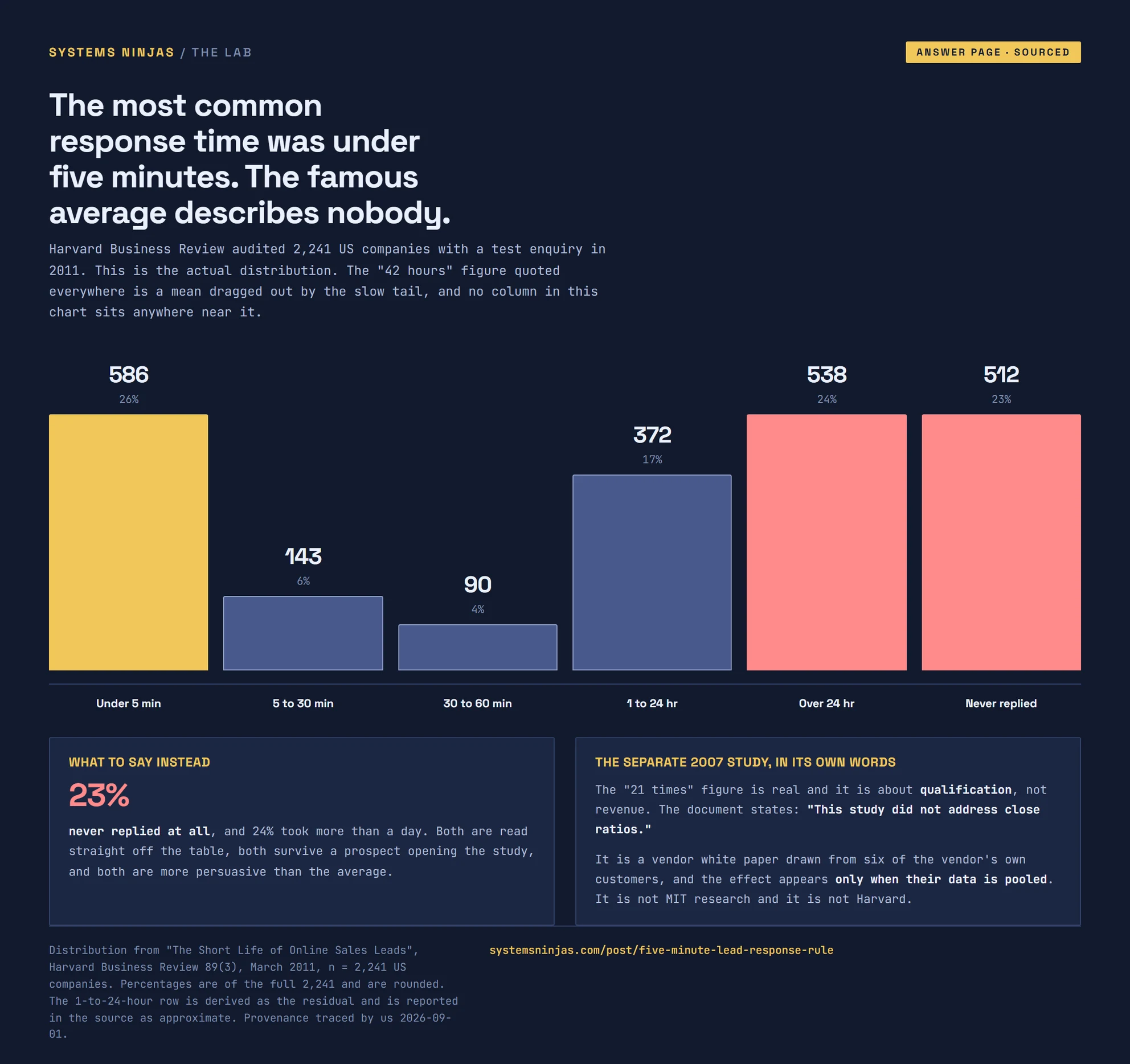
Harvard Business Review, March 2011, The Short Life of Online Sales Leads. The researchers sent a test enquiry to 2,241 US companies and timed the replies. This one is real, you can go and read it, and it is clear about what it measured.
| Response time | Companies |
|---|---|
| Under 5 minutes | 586 (26%) |
| 5 to 30 minutes | 143 |
| 30 to 60 minutes | 90 |
| 1 to 24 hours | ~372 |
| More than 24 hours | 538 |
| Never replied at all | 512 (23%) |
Look at the top row before you quote the famous one. The most common thing companies did was answer in under five minutes.
The "42 hours" figure is an average, and a small number of very slow companies drag that average up. Picture ten people standing in a room. Nine earn an ordinary wage and one is a billionaire. The average wage in that room is enormous, and it describes nobody standing in it.
The 42-hour company is that average. It does not exist in the data.
Quoting that average is not only weak. It is WRONG, and anyone sharp enough to open the study will see it at a glance.
The honest version of the same data works better anyway: 23% never replied at all, and 24% took more than a day. Both numbers are true, both come straight from the table, and both hold up when somebody checks them.
The study is also fifteen years old, and every company in it is American. That is why we run our own tests on this market instead of borrowing theirs.
06 / So what is it worthSo what is speed actually worth?
Here is what we will stand behind:
Speed does not close deals. It decides whether you get to have the conversation at all.
That claim needs no argued-over statistic to hold it up. It is what the 2007 study measured: getting hold of people and working out who was real, not money.
It matches the 2011 audit too, where a quarter of enquiries were never answered by anyone. And it still stands if the person you said it to goes and looks it up.
It also points at something a "respond in 5 minutes" slogan hides. Suppose your real problem is that 23% of enquiries never get a reply at all. Cutting thirty minutes off your average reply time fixes none of them.
A slow reply and no reply are two different faults. They need two different repairs.
07 / Our unproven beliefWhere fast may not be better, and we cannot prove it yet
Here is one thing we believe and have not measured. We are labelling it that way on purpose.
How fast a reply should feel is set by the CHANNEL it arrives on, not by the business sending it. The gap between the question and the answer is called latency.
In a chat box on a website, an instant answer feels like a person sitting at a desk waiting for you. On WhatsApp, an instant answer to a complicated question feels like a machine. Nobody types five thought-through paragraphs in eight seconds.
So the same gap can be a fault in one place and a giveaway in the other. On messaging apps, we think a reply that takes half a minute and has some thought in it beats an instant shallow one.
We have put that to a client in writing, together with a promise to undo it if the numbers on people walking away from the chat say otherwise.
That is a belief with a test attached to it, not a finding. We are not going to dress it up as one. When we have the numbers from our own traffic, we will publish them here whichever way they land.
08 / The question to askThe one question worth asking anyone selling you speed
Ask where the number came from. Then ask what it measured.
Most of the reply-speed statistics floating around trace back to one company's document from 2007. They usually arrive through a chain of blog posts, each one quoting the post before it.
That is a fair question to put to anyone quoting those numbers. Us included.
We fetched and read the original documents on 2026-09-01. We keep the full paper trail for these and eleven other industry statistics in-house, and our public claims policy sums it up: nothing goes on a client's page unless we can hand them the source.
Send us a statistic and we will trace it for you
Pick any number off an agency's landing page, including ours, and send it over. We will look for the primary document and tell you what we find, including when the honest answer is that the trail dies at a blog post with no sample size attached. It costs you nothing, and it is the fastest way to grade whoever is pitching you.
Trace a statistic [email protected] · No client of ours is named anywhere on this page, and if you become one, you will not be either.
Uldis Zalcmanis aka Systems Rockstar
Founder, Systems Ninjas · Kuala Lumpur
I build the automation and AI systems businesses actually run on, and I am the person who gets called when one of them quietly stops working. Born in Riga, based in Malaysia, father of two, and constitutionally unable to stop reading page source.
The Lab is where the measurements get published, including the ones that do not flatter us.