Do Customers Hate AI Chatbots? 6 Checks For A Bot They Trust
Free checklistFrom the video
Do customers hate AI chatbots? 6 checks for a bot they trust.
One A4 page. Use it before you switch a bot on, or to check the one you already have. No email needed. Free to print and share, as long as you keep the Systems Ninjas credit on it.
There's a belief spreading fast among business owners: my customers need a real human, and a bot will never work for my business.
It sounds smart. It sounds safe. But if you follow it, it costs you customers, time and your sanity, because it keeps YOU as the front line of everything.
Here is what I have actually seen: customers don't hate bots. They hate bad ones. One customer asked a bot we built out on a date. Another brought it a real gift. Below are the two stories, and then the 6 checks that separate a bot people trust from one that drives them away.
Two storiesThe customer who said sorry to a piece of code
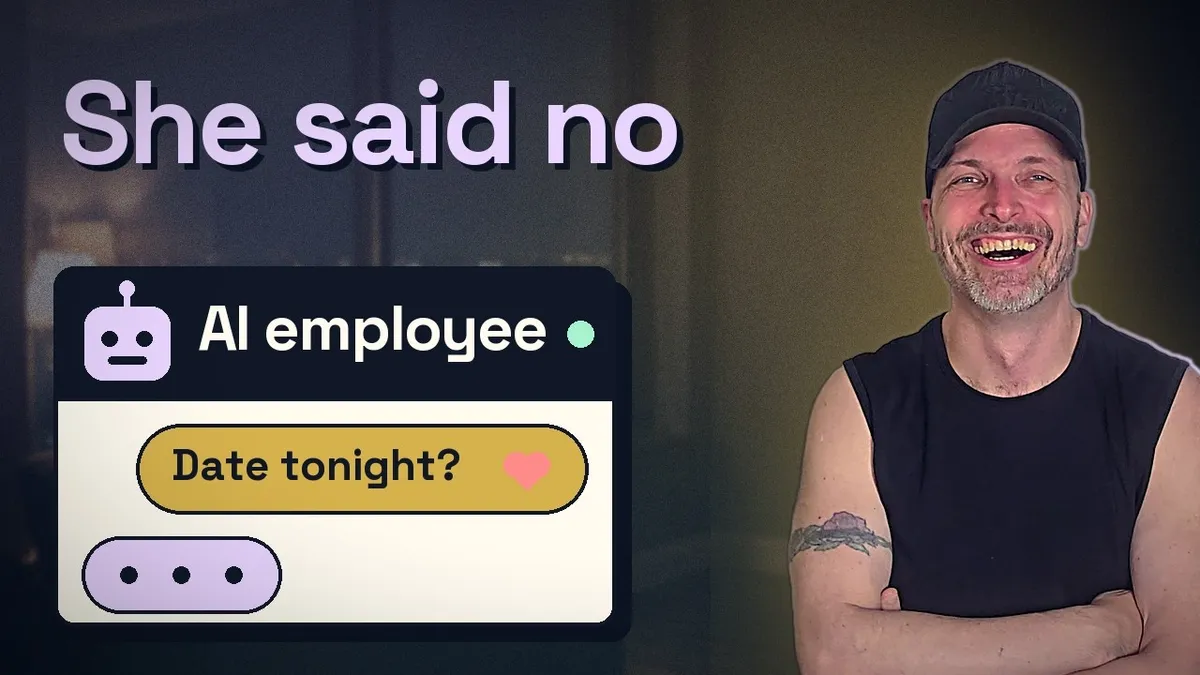
A man starts a chat on WhatsApp with an AI employee we built for a client. It talks like a real person: helpful, warm, honest. The chat goes really well. The man is enjoying it a lot. So he asks it on a date.
It says no, in a kind way. He tries again. It says no again. Still kind. Still honest. Then he finally asks: "Are you an AI?" It says yes. It even says sorry. And the man says sorry BACK. To a piece of code.
The second story came from the client. One day they messaged me because their staff were telling them about something unusual. One of their customers had come to the office with a real, physical gift. For the bot. He thought it was a real team member doing such a great job that it deserved a reward.
The real problemIt's not you. It's your system.
It's not your fault if you lose patience answering the same question five times. It's not your fault if you can't reply to messages in the middle of the night. That's normal. You are human.
The problem is your system. Right now it makes you the front line. YOU answer every message. YOU are the one glued to the phone, at dinner, at bedtime, on weekends. You wake up, check your phone, and a pile of messages is waiting. You answer during breakfast. You answer during your kid's birthday party. You answer before bed. That's not a business. That's a prison.
And it's fixable. The video gives four reasons AI employees work so well on the front line, plus the one mistake that turns a helpful bot into a customer repellent overnight. Each one is a check you can run on your own bot.
The 6 checksRun them on your bot, or on the one you are about to buy
-
1It answers the same question the same way, every single time.
Think about the last time a customer asked you something you had already answered two messages above. How did that feel? For me, not great. I get frustrated, and I'm honest about that. A well-built bot answers the fifth repeat calmly and helpfully, like it's the first time it has heard it.
WhyA lot of what businesses get is the same questions, over and over. Nothing complex. Nothing that needs a skilled person. Just a good answer, fast. You cannot keep that patience up forever. Nobody can, and you shouldn't have to.
-
2It answers at 3 AM as warmly as at 3 PM.
Someone messages at three in the morning, excited about something. The bot is excited with them. It responds warmly and genuinely engages. It doesn't sleep, it doesn't get tired, it just answers. AI handles the routine stuff, and you step in only when a real human touch is needed.
WhyBeing available around the clock yourself is what's killing you. Being available around the clock through a system is what keeps the customer.
-
3It fits the customer: their language, their style, their slang.
I speak three languages and I'm proud of that. A good bot speaks dozens. And it's not only the language. It picks up how the customer talks. Here in Malaysia people mix English and Malay very naturally. We call it Manglish. It's not an official language, but a well-built bot speaks it.
WhyThe customer feels like they are talking to someone local. Someone who gets them. That builds trust fast, and trust keeps customers.
-
4Asked "are you a real person?", it tells the truth.
It says it is AI. No tricks. No pretending. In the date story, that's exactly what happened: asked straight, it said yes, and it even said sorry.
WhyHonesty is part of building it right. And when you build it right, something shifts: people don't just accept the AI. They like it. They TRUST it.
-
5When it needs a human, it hands over cleanly.
When a conversation gets complicated, when a customer really needs a person, the bot knows that too and passes it on. Clean handoff. Right person, right time.
WhyThat's how you keep customers happy, and that's how you keep your brand safe.
-
6It is never rude, passive-aggressive or cold.
This is the one mistake that turns a helpful AI employee into a customer repellent overnight. The tone is not decoration. It's built in, on purpose, and it can be built wrong.
WhyI know because I tested it. Once I made a mean, passive-aggressive version of one of our bots just for fun. It was funny to watch, but it made people feel bad, and customers left fast. That was a short experiment.
Read it twiceLiked is good. Mistaken for a person is not the goal.
The gift story is funny. It's also worth a second look. A customer liked the bot so much he wanted to thank it, and he thought it was a person. Warmth is the point. Being mistaken for a human is not.
A bot can be warm, patient and local and still never claim to be a person. Whether you must also say it is AI in the very first message depends on where your customers are. We wrote that up separately in do you have to disclose an AI chatbot.
What comes nextBuilding it is one thing. Building it RIGHT is another.
Every time I work with the systems I build, I honestly think they are better humans than I am. More patient, more consistent, never short with anyone. But only because somebody built them that way.
The obvious next question is: how do I make sure my bot never goes rogue, never traps a customer in a loop and never embarrasses my brand? That is what 9 Guardrails Every AI Chatbot Needs Before Launch covers, including what happened when I tested a billion-dollar company's bot against them. Because building the AI is one thing. Building it RIGHT is what your customers will actually remember.
Want a bot your customers actually like?
That is what we build at Systems Ninjas: AI employees that are patient, warm and local, are honest that they are AI, and hand the real conversations to your team.
See what we build
Uldis Zalcmanis aka Systems Rockstar
Founder, Systems Ninjas · Kuala Lumpur
I build the automation and AI systems businesses actually run on, and I am the person who gets called when one of them quietly stops working.