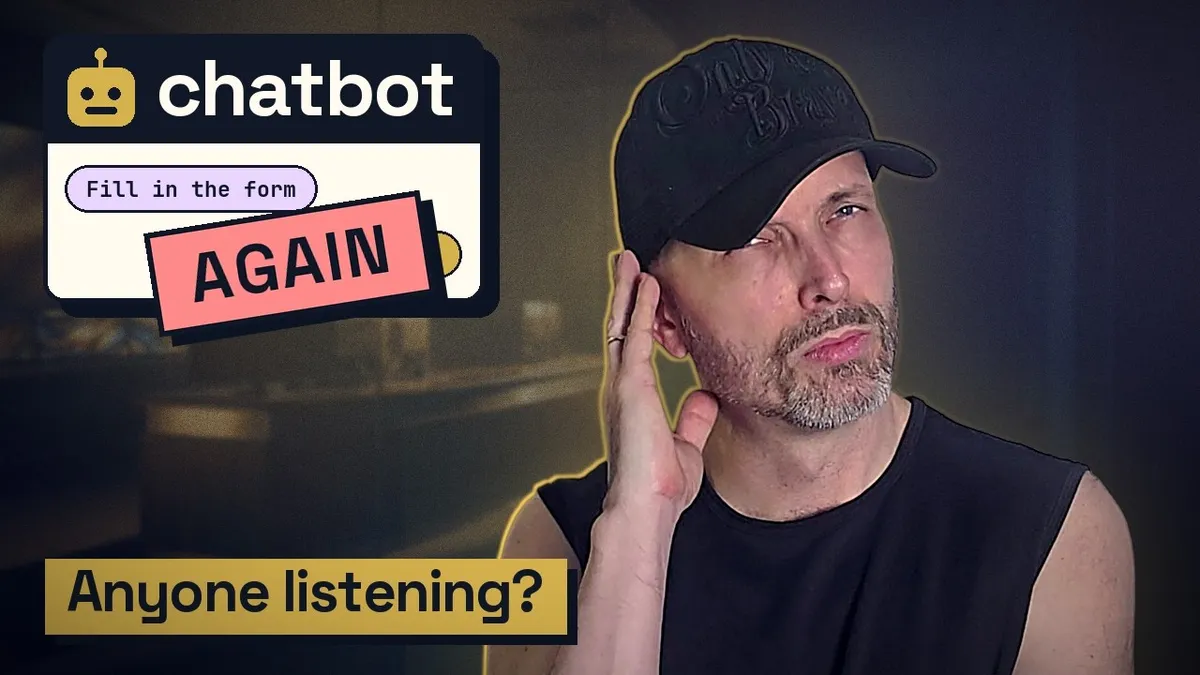
9 Chatbot Guardrails To Check Before You Go Live
Free checklistFrom the video
Before your chatbot goes live: 9 guardrails.
One A4 page. Run your bot through it before it goes live, or hand it to whoever is building it for you. No email needed. Free to print and share, as long as you keep the Systems Ninjas credit on it.
If your bot can't do certain things, you don't have customer support. You have an automated frustration machine.
Even big, well-funded companies are training customers to hate chatbots this way. The real problem isn't the AI. It's the humans who built it.
Here are the 9 guardrails every serious AI employee needs, with the reason behind each one. Put them in place before you go live. If your bot fails even a couple, you've got work to do.
The storyThe form, the form, and the form again
I wasn't playing with some free toy bot. I was dealing with a very big tech company I have paid for years. Their first line of support is a chatbot, which is fine with me, as long as it helps me fix the problem. Real money was on the line while the bug ran in the background.
I described the issue clearly. The bot sent me to a form, when everything in it could have been asked right there in the chat. Fine, I filled it. Then nothing. No follow-up, no ticket update, no human.
So I went back and said it was urgent. It sent me to the same form. Again. Even though tracking "customer X submitted form Y at this time" is basic customer journey tracking.
So I tested the guardrails. "I need to talk to a human." Form. "Can I speak to a real person who can look up my case?" Form. Then, in all caps: STOP SENDING ME THE SAME NONSENSE. I wasn't raging for fun. I was trying everything a normal, angry customer would try. The bot registered none of it. No "I'm sorry you're frustrated", no "let me connect you to an agent". Just the same dead script.
Who failedThe AI didn't fail. The design did.
From my side of the table, as someone who builds these things, the AI didn't fail. The human who set it up didn't build what needed to be built. No context. No escalation. No memory. No guardrails.
So if you're worried that AI will make your company look incompetent: it's rarely the AI. It's almost always the lack of systems around it. And that's fixable.
The 9 guardrailsTick every one before your bot goes live
-
1There is a reliable way out to a real human.
"Talk to a person", "real agent", "call me", "operator": the bot should understand all of them, not one magic keyword someone hardcoded at midnight. And it should actually hand me to a human, not send me back into the loop. If nobody is online, it says so, and offers to schedule a call, take it by email, or request a callback.
WhyNo working human handoff, no real customer support. Everything else is an automated frustration machine.
-
2It notices frustration and changes how it behaves.
Not therapy. Just "this person is clearly upset" awareness: caps, insults, repeated failed attempts, "this is useless", "you're not listening". When it sees that, it slows down, acknowledges the frustration, offers a simpler option, or escalates straight to a person.
WhyA bot that ignores frustration tells the customer nobody is listening. Once they believe that, they're already halfway gone.
-
3It remembers what already happened.
Your bot needs a memory longer than a goldfish. It should know when a form was submitted, which route already failed, and what is still pending. "I see you already sent us a form about your billing issue. Want me to check the status?" That one sentence would have changed my whole experience. And if a route didn't work, don't send me down it again.
WhyBanks and government offices already hand us the same form again and again. A bot that does it copies the worst parts of bureaucracy, instead of showing it understands my situation.
-
4Your escalation rules are written down and tested.
Escalation can't depend on the customer typing "human". That's lazy. Set clear rules: if the same request fails 3 times in a row, escalate. If the topic is high-risk, like billing, fraud or an outage, escalate. If it's a VIP or high-value customer, escalate faster. If the customer stays strongly negative, escalate.
Why"We assume the vendor handled that" is not a rule. If you don't check, they probably didn't.
-
5The human who takes over sees the whole story.
The agent should see the full chat, who the customer is, what the bot already tried and where it failed. And the bot should say what is happening: "I'm connecting you to a human right now. They'll see everything we've done so far."
WhyExplain, get transferred, explain it all again: a bot that makes people repeat their story has automated the worst human experience.
-
6The bot has tight limits, and someone is watching it.
Check who is asking and what they're allowed to do. Protect the data while it travels and while it's stored. No changing billing data or issuing refunds without logging and safeguards. Then watch it: logs, alerts for weird behaviour, and a plan for when someone tries to abuse it.
WhyA careless bot is a new way into your systems. No god mode, or you're giving a very enthusiastic raccoon the keys and hoping it behaves.
-
7It's warm, inside clear limits.
People send our bots baby pictures and ask for career advice that has nothing to do with the business. I love it, because the bot can still say "He's so cute, you're so lucky to have him." But risky topics get hard boundaries: self-harm, medical advice, financial decisions, abuse and harassment. There, a clear fallback: "I'm not able to help with that, but here are some resources", or "Let me connect you to a trained human."
WhyNot a bot that says anything to anyone about anything. One that is kind and encouraging, and stays inside clear safety rails.
-
8It's honest about what it can't do, and never pretends to be human.
"I'm not able to process billing changes, but I can connect you to someone who can." No looping people forever in a fake solution. And "I'm an AI assistant" is a perfectly fine sentence. More on that in do you have to tell people they're talking to a bot?
WhyPeople can handle limits. What they can't handle is being misled and dragged in circles.
-
9There's a feedback loop, and someone acts on it.
Give people a way to say "this didn't help" or "this solved it". Watch where they get stuck, where they quit, and where escalations happen. Then act: tweak the flows, adjust the triggers, refine the training. A human needs the same feedback many times. A bot you've fixed for a situation stays fixed, and does it every time.
WhyVersion one of a bot is never the final version. The loop turns a rough draft into an asset that keeps getting better. Here is what happens to a bot nobody looks after.
Try it yourselfRun my stress test on your own bot
Try everything a normal, angry customer would try, the way I did:
- Ask for a human in several different ways, not just the one word you think it listens for.
- Tell it the problem is urgent.
- Do what it asks, then come back and see if it knows you did.
- Get frustrated in capitals, and see whether anything changes.
If it fails even a couple of these, you've got work to do.
All nine, togetherFrom a bot to an AI employee
When people say "AI chatbots are garbage", most of the time they're reacting to bad human design, not to the AI. Layer in these 9 guardrails and people stop seeing a bot and start seeing an AI employee that respects their time.
Next step: Why Your Business Chatbot Is Stuck at Level 1 walks through the levels of AI employees, from the simplest setup to a full team of bots.
Want a bot that hands people to a human properly?
That is what we build at Systems Ninjas: AI employees with the guardrails in place before they go live, and kept improving after.
See what we build
Uldis Zalcmanis aka Systems Rockstar
Founder, Systems Ninjas · Kuala Lumpur
I build the automation and AI systems businesses actually run on, and I am the person who gets called when one of them quietly stops working.